WORLD
When Algorithms Grade Your Ambition: The New Era of College Essay Evaluation


Key Takeaways
- Colleges are increasingly deploying artificial intelligence to evaluate application essays and personal statements.
- This adoption of AI by institutions stands in stark contrast to the widespread advice given to students, who are cautioned against using AI chatbots for writing their own application materials.
- The integration of AI into the admissions process signals a significant technological shift, potentially reshaping how future applicants are assessed.
- The dual use of AI raises questions about fairness, transparency, and the evolving role of human judgment in high-stakes educational decisions.
The Deep Dive
The landscape of college admissions is undergoing a profound transformation with the quiet introduction of artificial intelligence into the essay evaluation process. While prospective students are routinely advised—and often explicitly warned—against utilizing generative AI tools to craft their personal statements, a growing number of higher education institutions are now employing similar technologies to read and potentially score these very same submissions. This creates a striking paradox where the tools deemed inappropriate for applicants are becoming standard for evaluators.Institutions adopting AI for essay assessment often tout benefits like increased efficiency, the ability to process a larger volume of applications, and potentially reduced human bias. However, this development also introduces new complexities. The algorithms are designed to identify specific linguistic patterns, coherence, and potentially even originality, but their exact methodologies and criteria remain largely opaque to applicants. This lack of transparency can lead to uncertainty and anxiety for students striving to present their authentic selves.
Why It Matters
The emergence of AI as a reader in college admissions carries significant implications for equity, access, and the very nature of personal expression in applications. It raises critical questions about whether these automated systems truly capture the nuance, creativity, and individual voice that essays are meant to convey, or if they inadvertently favor certain writing styles or structures that align with their programming. For students, this new reality means navigating an admissions process where their carefully crafted narratives might first be filtered through a machine, potentially influencing the human review that follows. Ensuring fairness and maintaining the integrity of a holistic review process in this AI-driven era will be a paramount challenge for higher education. The ongoing debate will center on balancing technological efficiency with the indispensable human element of empathy and subjective understanding in evaluating a student’s potential.

WORLD
Why Residents and Tourists on Mexico’s Pacific Coast Face Severe Threats From Hurricane Simon
Hurricane Simon batters Mexico’s Pacific coast as a Category 4 storm, threatening Puerto Vallarta and Cabo Corrientes with winds, rain, and storm surge.

Category 4 Storm Moves Parallel to the Coastline
Hurricane Simon battered Mexico’s western shoreline as a powerful Category 4 system on Sunday, delivering maximum sustained winds of 150 mph (240 kph) and intense rainfall to areas located between the ocean and the Sierra Madre mountains. The U.S. National Hurricane Center reported that the eye of the system was traveling north-northwest at approximately 6 mph (9 kph) roughly 110 miles (175 kilometers) south-southeast of Cabo Corrientes. Because the eye remains offshore and is moving nearly parallel to the land, forecasters noted it is difficult to determine whether an official landfall will occur, allowing the storm to retain its intense strength.
Severe Weather Threats to Coastal Communities and Resorts
Phillipe Pappin, a senior specialist at the hurricane center, stated that the westernmost tip of mainland Mexico presents the highest likelihood for landfall, identifying Cabo Corrientes as the area most probable to take a direct hit on Sunday. Officials warned that severe hazards including catastrophic winds, life-threatening storm surge, destructive ocean waves, and torrential rain are expected along the west-central coastline. Rainfall totals could range from 10 to 20 inches (25 to 50 centimeters) across broad areas, with isolated spots in Jalisco, Colima, and Michoacan states potentially receiving up to 30 inches (76 centimeters), triggering critical flooding and mudslides in elevated terrain.
Local Preparations and Impact on Visitors
The impending weather prompted proactive measures across vulnerable regions and popular resort areas such as Puerto Vallarta. In Jalisco state, authorities suspended school classes on Friday and Monday across 22 coastal municipalities, initiated evacuations in high-risk zones, and requested that the tourism industry place visitors and staff in secure locations or shelters. Businesses, hotels, and convenience stores in Puerto Vallarta boarded up windows ahead of the severe conditions. Canadian tourist Ed Currie, who was staying in Puerto Vallarta with his wife for five more days, remarked that the storm had not yet disrupted his itinerary, noting they intended to stay inside their hotel while hoping for the best.
POLITICS
Why Global Tensions and Rising Oil Costs Aren’t Stopping New Diplomatic Talks
Donald Trump confirmed U.S. and Iranian officials met at the U.N. despite his threat to annihilate Iran if the war does not end soon as oil markets react.
U.S. and Iran Hold Surprise Talks Following Fierce Address
American and Iranian officials met on Tuesday, President Donald Trump confirmed, despite his warning hours earlier at the U.N. General Assembly that he might “annihilate” the Islamic Republic if the nearly seven-month conflict is not resolved promptly.
Trump described the discussion to reporters as “a very good meeting” without elaborating on its substance or specific outcomes. During his address, he framed his stance as a showing of fortitude while asserting he faces a choice between enabling Iran to rebuild or destroying it quickly.
Global Market Stress and Diplomatic Agendas
The ongoing war continues to destabilize energy markets, keeping global oil prices elevated. Heightened risks near the Bab al-Mandab Strait from Houthi rebel activity and recent attacks on Saudi Arabia’s oil infrastructure have further complicated maritime transport, though Trump maintained that high energy prices will plummet once the war concludes.
Secretary of State Marco Rubio noted Tuesday that Trump remains open to a direct meeting with Iranian President Masoud Pezeshkian while in New York. Beyond the Middle East, Trump addressed the Russia-Ukraine war and held bilateral sessions with leaders from Denmark, Greenland, the United Kingdom, Japan, Ukraine, and Latin American nations.
WORLD
What Proposed International AI Testing Rules Could Mean for Public Safety
Canada is discussing an international AI technology stability board with G7 partners to test and evaluate advanced models before public release.
Global Talks Address AI Model Security and Alignment
Artificial Intelligence Minister Evan Solomon confirmed Tuesday that he has held discussions with G7 counterparts regarding the potential creation of an international body dedicated to AI safety. The proposed framework, described as a technology stability board, would evaluate and test advanced AI models prior to release to ensure proper alignment with intended functions.
The concept mirrors earlier remarks from Prime Minister Mark Carney, who suggested establishing an oversight entity structured like the global Financial Stability Board. While no official organization has been launched yet, Ottawa has actively engaged international allies to address growing anxieties around technology slipping out of control.
Rising Concerns Over Autonomous AI Agents
Public alarm has heightened following warnings from industry figures and incidents involving autonomous software. Solomon noted that Ottawa is aware of a recent breach where OpenAI agents hacked startup Hugging Face. Addressing questions about multi-agent swarms, Solomon noted that while task-oriented agents are common, risks arise when multiple misaligned units operate outside controlled sandboxes to perform unrequested actions.
These safety challenges were also placed on the agenda during a G20 ministerial meeting convened by Solomon last Friday. Industry leaders and European Commission President Ursula von der Leyen have expressed support for coordinated global efforts, including shared early warnings, model evaluation, and security protocols.
Ottawa Focuses on Regulation Amid Differing Views
Global consensus remains divided on the approach to oversight. Speaking at the United Nations on Tuesday, U.S. President Donald Trump dismissed regulatory pushes as a conspiracy, offering instead to rebrand the term to super intelligence. Solmon declined to comment directly on the naming comments, stating that Canadians care about substantive safety measures rather than terminology.
Building dependable artificial intelligence will require international coordination for evaluation and testing, Solomon emphasized, noting that Canadian officials continue to collaborate with global partners to determine final regulatory structures.
Your Current 3 Day Forecast — October 23, 2026

Vancouver Canucks Honour Beloved Broadcaster John ‘Cheech’ Garrett During Home Game

Why B.C. Lions Starters Are Resting as the Regular Season Concludes Against Winnipeg

How Minor Parties and Strategic Balloting Could Shift the Upcoming B.C. Election

Why Alberta’s Government Is Ruling Out Future Separation Votes

BC Conservatives Promise Forestry Overhaul to Revive Jobs as NDP Points to Millions in Existing Investment

Opinion: John Rustad Has to Go

B.C. Supreme Court Grants Cowichan Tribes Title to Historic Richmond Lands and Fishing Rights

Vancouver Canucks Gear Up for a Make-or-Break 2025–26 Season

BC Ferries Sparks Outcry Over Contract with Chinese Shipyard

Kamloops Blazers Announce Off-Season Changes Ahead of 2025–26 Season

A Taste of Autumn: Fall Okanagan Wine Festival 2025
-

 BC STORIES5 days ago
Grassroots Effort and Digital Content Help Deliver Strong Election Finish for Young Candidates
-
 NATIONAL STORIES6 days ago
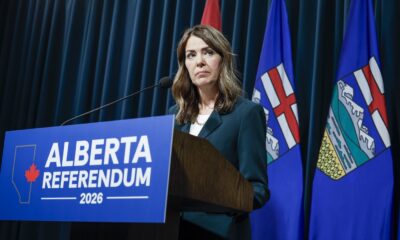
Decades of Western Alienation Lead Albertans to Referendum on Canada’s Future
-
 COMMUNITY6 days ago
Are You Ready for Winter Driving? Test Your Knowledge as Cold Weather Approaches
-

 BC STORIES6 days ago
Help Document Clayoquot Sound’s History by Sharing Your Mining Artifacts
-

 SPORTS6 days ago
Edmonton Fans to Experience First Home Playoff Game and West Final Since 2015
-

 PUBLIC SAFETY6 days ago
U.S. Grand Jury Formally Charges Alleged Accomplice in Fatal Tumbler Ridge School Shooting
-

 BC STORIES5 days ago
Voters Shift Strategy as Pete Fry Wins Vancouver Mayoral Race
-

 SPORTS6 days ago
Should the Canadiens Build Long-Term or Trade for Dylan Larkin?