HEALTH
Why You Might Want to Think Twice Before Wearing Shorts on a Plane


Why You Might Want to Think Twice Before Wearing Shorts on a Plane
By The Current
If you’re heading somewhere warm, shorts might seem like the obvious choice for the flight.
According to some flight attendants, you may want to reconsider.
Veteran flight attendant Charity Nelms recently offered travellers a rather unpleasant piece of advice: wear pants on the plane.
Nelms, who has worked as a flight attendant for more than a decade, says passengers would probably be surprised by what airline seats encounter between cleanings.
“I am letting you know, from a flight attendant, the amount of things I have seen on the seat,” Nelms said in a TikTok video.
Her recommendation was straightforward: avoid shorts, skirts and dresses if they leave your legs directly touching the seat.
“Wear full pants,” she urged.
And she isn’t the only flight attendant making the case.
Dallas-based flight attendant Cher Killough shared an even more graphic example, saying she witnessed four diapers being changed directly on passenger seats during a single flight.
All four, she said, contained more than just a wet diaper.
It’s the kind of information that can make you look at your economy-class seat a little differently.
How Clean Is Your Airplane Seat?
Airplanes are cleaned regularly, but the level of cleaning depends heavily on the aircraft’s schedule.
Between flights, crews generally conduct relatively quick turnaround cleanings. The priority is typically removing garbage and cleaning high-use areas such as lavatories and galleys so the aircraft can get back into service.
Aircraft parked overnight may receive a more substantial cleaning, including greater attention to passenger seating areas.
Then there are deep cleans.
Those can involve much more extensive work around seats, storage compartments and other parts of the cabin that passengers regularly touch.
The catch is that deep cleaning doesn’t necessarily happen after every flight—or even every few flights.
Schedules vary considerably between airlines.
That means hundreds of passengers may occupy a seat between more intensive cleanings.
Don’t Forget the Seatbelt
Nelms says the seat itself isn’t the only thing travellers should think about.
One of the most frequently handled items on an aircraft is sitting directly across your lap: the seatbelt.
Passengers grab the buckle, adjust the strap and pull on the belt throughout every flight.
Nelms recommends wiping down both the metal buckle and the fabric portion of the belt when you sit down.
Why?
Because everything from spilled drinks to food, baby vomit and other bodily fluids can potentially end up on them.
It isn’t exactly something airlines highlight in their safety demonstration.
And Please Wear Shoes to the Bathroom
There is another piece of flight-attendant advice worth remembering.
Don’t walk into an airplane lavatory wearing only socks.
Anyone who has flown regularly has probably encountered a mysterious wet floor inside an aircraft bathroom.
Nelms’ warning is simple: don’t automatically assume that liquid is water.
Socks also absorb whatever happens to be on the floor, meaning you’re potentially carrying it back to your seat.
Wear your shoes.
The Current Takeaway
There’s no reason to become paranoid every time you board an airplane.
But a little common sense probably doesn’t hurt.
Airliners carry hundreds—or sometimes thousands—of passengers over a relatively short period of time. Turnaround schedules can be tight, and cleaning crews don’t necessarily have the opportunity to scrub every surface between flights.
So the next time you’re getting dressed for the airport, you might want to consider three simple things:
Wear pants. Wipe down the surfaces around your seat. And keep your shoes on when visiting the bathroom.
It may not be the glamorous side of air travel.
But sometimes the things flight attendants know are exactly the things passengers would rather not think about.

BC STORIES
What 5 Neurologist Resignations Mean for Regional Health Care at Interior Health
Five Interior Health neurologists have resigned following expanded regional on-call demands, adding to previous physician departures in the B.C. region.
Five Specialists Step Down Following Regional On-Call Mandate
Five neurologists have resigned from their positions with Interior Health after being required to expand their on-call coverage across the entire health authority region via internet and telephone services. According to Doctors of B.C. president Adam Thompson, the mandate served as a tipping point after physicians expressed that the arrangement was not viable, citing concerns over workload levels.
Pattern of Physician Departures Across Regional Facilities
The decision marks another instance of staff departures within the health authority. Previous incidents include the resignation of all obstetricians and gynecologists at Kamloops’ Royal Inland Hospital last October due to workload, alongside four psychiatrists leaving Vernon Jubilee Hospital that same month. Furthermore, seven pediatricians resigned from Kelowna General Hospital between 2023 and 2025, which led to an internal report highlighting a decline in trust between physicians and administration.
Calls for Collaboration and Health Authority Response
Thompson stressed that health authority administrators must listen to and collaborate with frontline physicians to address ongoing service issues across provincial specialties. In response, Dr. Kirstie McLelland, executive medical director of clinical operations for Interior Health South, stated that election-period communication rules limited detailed comment, but affirmed that the authority remains committed to working with neurologists to meet staff rules and bylaws while delivering required care. She added that members of the public should not hesitate to seek neurology services if needed.
BC STORIES
B.C. Faces an Early and Hard-Hitting Flu Season as Symptoms Intensify
B.C. flu season arrives early as Health Canada reports elevated activity. Learn about the dominant H1N1 strain, severe symptoms, and vaccine availability.

Early Arrival and Severe Symptoms
Influenza activity in British Columbia has surged earlier than usual this year, bringing illness that health professionals describe as particularly intense. According to Health Canada data, flu test positivity across the province is running above average for this time of year, departing from the typical pattern where cases climb slowly toward a holiday peak.
Pharmacists note that the current wave is taking a heavier toll on patients compared to last year. Pharmasave pharmacist Fairuz Siraj stated, “This year it’s hitting hard. We’re seeing a lot of cases of people coming down, feeling ill, and taking more time to recover. A lot more severe type of illness than what we saw last year.”
Dominant Strain and Vaccine Alignment
Data from the Public Health Agency of Canada and the BC Centre for Disease Control show that B.C. registered a “moderate” flu activity level during the first week and a half of October, with wastewater indicators rising at multiple monitoring locations. Meanwhile, other Canadian provinces continue to report “low” or “very low” activity.
The dominant virus strain in circulation is H1N1, a form of Influenza A. On Oct. 7, B.C. Provincial Health Officer Dr. Bonnie Henry announced the launch of the provincial vaccination campaign 10 days ahead of the usual schedule. Because scientists anticipated that H1N1 would lead cases this season, the current vaccine was formulated specifically to target it. Dr. Brian Ward, a scientist at the McGill University Health Centre, noted that “so far, so good,” though he cautioned that flu viruses can mutate as the season progresses. Ward added it remains too early to know if mid-season mutations will occur and stated he is unaware of any predicted mutations that would reduce vaccine efficacy.
Vaccine Access Details
Free influenza immunizations are currently accessible to B.C. seniors and individuals in high-risk categories. Siraj advised that members of the general public seeking early protection may check walk-in clinics for availability or wait for their individual booking notification links, which are expected in late October or early November.
HEALTH
Coquihalla Highway Reopens Near Merritt Following Morning Crash That Injured Four
The Coquihalla Highway north of Merritt has reopened following a Saturday morning vehicle crash that resulted in four people being taken to the hospital.
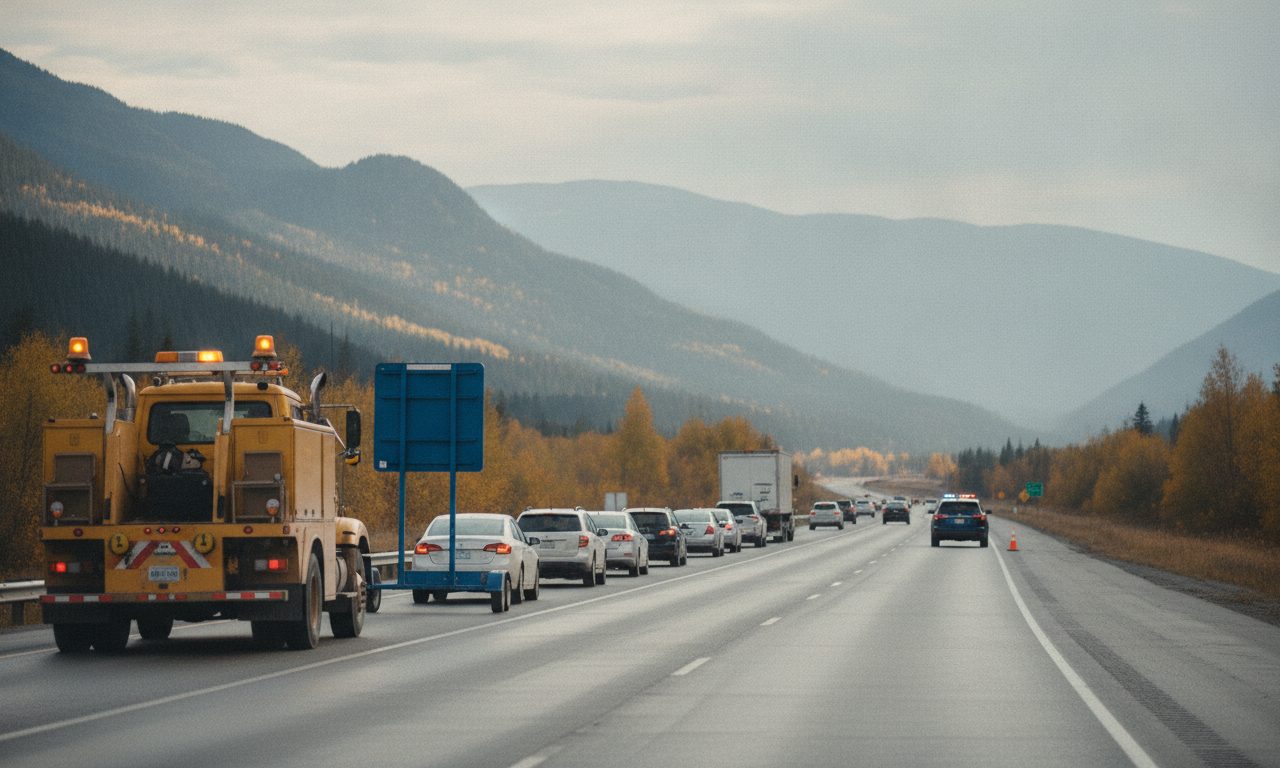
Traffic Resumes Following Serious Morning Incident
Four people were hospitalized, including three in critical condition, after a motor vehicle incident occurred north of Merritt on Saturday morning, October 17.
DriveBC reported that the Coquihalla Highway was reopened in both directions from Exit 290 to Exit 315 at approximately 4:00 p.m., following the earlier closure.
Emergency Responders Deploy Air Ambulances
BC Emergency Health Services dispatched multiple resources after receiving a call at approximately 8:35 a.m. The response included two air ambulances, three primary care paramedic ambulances, one advanced care paramedic ambulance, and a paramedic supervisor.
According to BCEHS, crews provided emergency medical care at the scene. Two of the three critically injured patients were flown to the hospital via air ambulance, while a fourth patient was taken to the hospital in stable condition.

Why the Early Election Gamble Backfired on the NDP

Why Fake Signs Targeted a Small Green Party Campaign on B.C. Election Eve

Why the Conservatives’ Majority Win in Kelowna-Mission Signals Big Changes for Local Healthcare and Economy

Why B.C.’s Latest Election Results Are Sparking Renewed Calls for Voting Reform
Your Current 3 Day Forecast — October 27, 2026
Why First Nations Leaders Are Gathering in Ottawa to Push Back on Fast-Tracked Resource Projects

Opinion: John Rustad Has to Go

B.C. Supreme Court Grants Cowichan Tribes Title to Historic Richmond Lands and Fishing Rights

Vancouver Canucks Gear Up for a Make-or-Break 2025–26 Season

BC Ferries Sparks Outcry Over Contract with Chinese Shipyard

Kamloops Blazers Announce Off-Season Changes Ahead of 2025–26 Season

A Taste of Autumn: Fall Okanagan Wine Festival 2025
-

 SPORTS5 days ago
Why B.C. Lions Starters Are Resting as the Regular Season Concludes Against Winnipeg
-

 BC STORIES5 days ago
BC Conservatives Promise Forestry Overhaul to Revive Jobs as NDP Points to Millions in Existing Investment
-

 OPINIONS5 days ago
How Minor Parties and Strategic Balloting Could Shift the Upcoming B.C. Election
-

 BC STORIES6 days ago
Police Seek Witnesses After Fatal Wrong-Way Collision Near Merritt
-
5 days ago
Your Current 3 Day Forecast — October 22, 2026
-
6 days ago
Your Current 3 Day Forecast — October 21, 2026
-
NATIONAL STORIES6 days ago
Highland Valley Copper Workers Could Strike Saturday as Union Issues Notice
-

 HEALTH6 days ago
Coquihalla Highway Reopens Near Merritt Following Morning Crash That Injured Four