POLITICS
Quebec Voters Weigh Political Promises and Slogans as Election Campaign Kicks Off
A new Synopsis poll shows a tight Quebec election race between the PQ and CAQ as party leaders launch platforms, address tariffs, and present campaign slogans.


Polling Shows Narrowing Gap Between Top Parties
As campaign activity gets underway for Quebec’s October 5, 2026 election, a Synopsis Recherche poll for La Presse shows a tight contest at the top. Among decided respondents, Paul St-Pierre Plamondon’s Parti Québécois (PQ) leads with 28 per cent support, while Christine Fréchette’s Coalition Avenir Québec (CAQ) has risen seven points to 27 per cent. The Quebec Liberal Party (PLQ), led by Charles Milliard, sits at 20 per cent following a six-point drop. Éric Duhaime’s Conservative Party (PCQ) holds 14 per cent, and Ruba Ghazal’s Québec Solidaire (QS) stands at 10 per cent.
Synopsis partner Youri Rivest noted that half of the CAQ’s recent gains came directly from former Liberal supporters. Responding to the shift during a briefing in Sherbrooke, Milliard stated that voters moving to the CAQ were making a mistake, adding, “I’m going to make sure that doesn’t happen.” He emphasized that campaigns are just starting and outlined an economic strategy to lower exports to the United States by at least 15 per cent by strengthening ties within Canada, Europe, and Francophone regions. He also proposed reducing corporate tax rates for small and medium enterprises from 11.5 per cent to 9.5 per cent, funded by cutting state overintervention and eliminating the Fonds de développement économique.
CAQ Defends Record and Proposes Family Benefits
During a campaign stop in Rimouski, Fréchette cited favorable poll numbers showing her as the preferred choice for premier at 26 per cent, compared to 23 per cent for St-Pierre Plamondon. In Disraeli, Fréchette addressed criticisms from opponents regarding economic management, hinting at plans to tighten criteria for business subsidies. She noted that as Minister of the Economy, she halted public funding for Northvolt and Lion Electric, though she declined to specify at what exact stage of review that decision was finalized. St-Pierre Plamondon had earlier accused her of misrepresenting her role in the collapse of the battery plant project.
For her party’s initial policy proposal, Fréchette announced plans to expand the Quebec Parental Insurance Plan (QPIP). The proposal includes extending paternity leave by two weeks, increasing flexibility for extended family members, and improving benefits during perinatal bereavement, stating the self-funding program would not require premium increases. The CAQ also introduced new regional candidates, announcing Marc Grandbois for Dubuc and François Cormier for Lac-Saint-Jean.
Voter Priorities, Grocery Bills, and Campaign Slogans
Voters across the province are weighing key policy platform commitments alongside party messaging. In Sherbrooke, Québec Solidaire candidate Ruba Ghazal presented measures targeting major grocery chains to curb food prices. The QS platform includes capping profit margins for large grocery chains at 15 per cent, banning dynamic pricing and fake discounts, and establishing a network of 15 public grocery stores.
Voters are also reacting to election signs popping up province-wide. The CAQ is campaigning on “Avançons” (“Let’s move forward”), while the PQ has selected “Le choix de la confiance” (“The choice of trust”). The Liberals are using “Rassembler. Réparer. Bâtir.” (“Unite. Repair. Build.”), QS offers “C’est possible” (“It’s possible”), and the PCQ presents “Oser pour vrai” (“Dare for real”). Communications strategist Martine St-Victor highlighted the QS and CAQ slogans as distinct, noting that institutional trust is a central challenge with under 60 per cent of Quebecers expressing trust in political institutions.
Survey results indicate healthcare remains the primary voter concern at 54 per cent, followed by inflation and cost of living at 41 per cent, and housing at 34 per cent. Concern over trade instability with the U.S. rose to 29 per cent, particularly among CAQ supporters. Meanwhile, support for Quebec independence remains steady, with 31 per cent in favor and 69 per cent opposed among those expressing an opinion. The Synopsis survey gathered responses from 1,009 Quebec adults between August 24 and 26, 2026.

BC STORIES
Why Fake Signs Targeted a Small Green Party Campaign on B.C. Election Eve
Green Party candidate Tim Binnema reported 100 to 200 fake election signs in Surrey-Fleetwood to Elections BC on the eve of the B.C. provincial election.
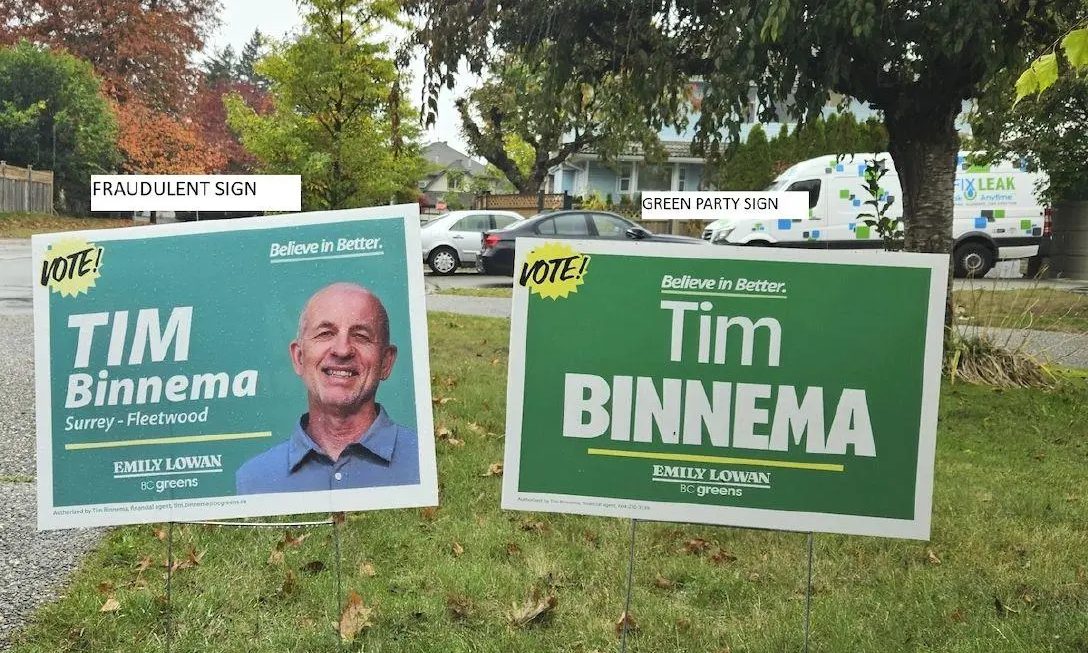
Unauthorized Signage Reported in Surrey-Fleetwood
Elections BC has been notified after between 100 and 200 unauthorized election signs appeared in Surrey-Fleetwood on the eve of the provincial vote. Green Party candidate Tim Binnema discovered the unauthorized material featuring his name and face on Oct. 23, the day before final voting ended.
Binnema, a manager at an engineering firm, noted that the signs contained key discrepancies compared to his official campaign materials. Unlike his legitimate signage, the unauthorized placards displayed his photo, which appeared to be taken directly from his campaign website. The signs also featured an incorrect shade of green and falsely claimed to be authorized by his financial agent.
Potential Vote-Splitting Tactics
The unauthorized placards were discovered near third-party political signs around Surrey and Fleetwood, particularly near 152nd Street and 96th Avenue. Binnema observed that his fake signs were positioned alongside materials expressing opposition to the government, such as “Vote NDP out” and “Why a snap election?” signs, suggesting a deliberate placement pattern.
The riding outcome saw Conservative candidate Garry Purewal secure victory with 8,691 votes, defeating NDP incumbent Jagrup Brar, who received 6,522 votes. Binnema finished in third place with 1,030 votes at the latest tally.
“It was shocking, to tell you the truth. When I turned around the corner and saw my mug (on signs), I thought, ‘Oh my goodness, how did this happen?’” Binnema said, adding that he ran a modest campaign with few signs and feels a responsibility to clear the fraudulent materials.
BC STORIES
Why the Conservatives’ Majority Win in Kelowna-Mission Signals Big Changes for Local Healthcare and Economy
Conservative Gavin Dew wins re-election in Kelowna-Mission as his party secures a majority government in B.C., promising action on healthcare and jobs.
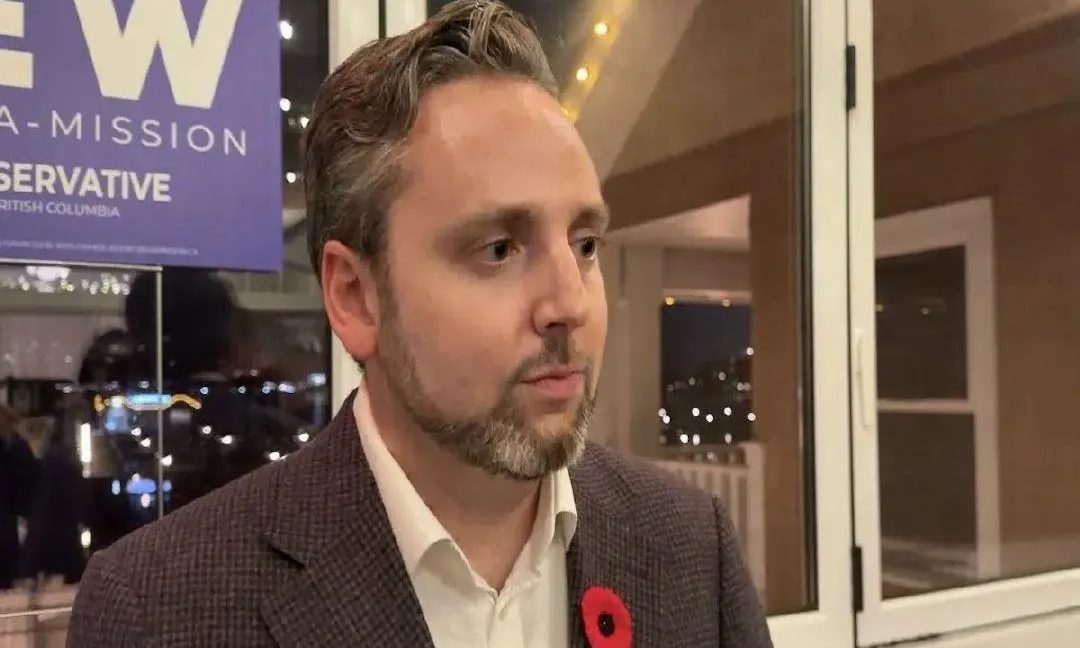
Big Blue Wave Ends Nearly a Decade of NDP Rule
Voters in Kelowna-Mission have chosen incumbent Gavin Dew to return as their MLA, helping propel the Conservative Party to a landslide majority victory across British Columbia on Oct. 24. Over one million voters participated in the election, effectively ending nine years of NDP governance under Premier David Eby, whose decision to call an early fall election backfired.
Dew, who secured nearly 60 per cent of the vote in his riding after first being elected in 2024, celebrated the result alongside family and supporters. He attributed the party’s rapid integration and strong campaign performance to leader Lorne Doerkson, who is projected to become the province’s next premier.
Local Priorities and Economic Focus
With the Conservatives moving from opposition into government, Dew emphasized that his focus will pivot toward delivering tangible improvements. His key local agenda includes opening unused spaces at Kelowna General Hospital, expanding mandatory care programs at Oliver’s Okanagan Correctional Centre, advancing regional transportation projects, and boosting overall economic recovery.
Addressing local economic pressures is a top priority, as Kelowna has recorded the highest unemployment rate among major Canadian cities for five consecutive months. Dew noted that a Conservative administration plans to target growth across key sectors such as tourism, housing, aerospace, and the local wine industry.
Preparing for Governance
Reflecting on the strong mandate received both locally and provincially, Dew expressed optimism as the new Conservative caucus prepares for its initial meetings. He indicated that transitioning into government will allow the party to take direct action on healthcare, public safety, and economic renewal for residents across the province.
BC STORIES
Why B.C.’s Latest Election Results Are Sparking Renewed Calls for Voting Reform
B.C. Conservatives won a majority of seats on Oct. 24 despite getting 48.1% of votes, prompting calls from Fair Vote Canada for voting system reform.
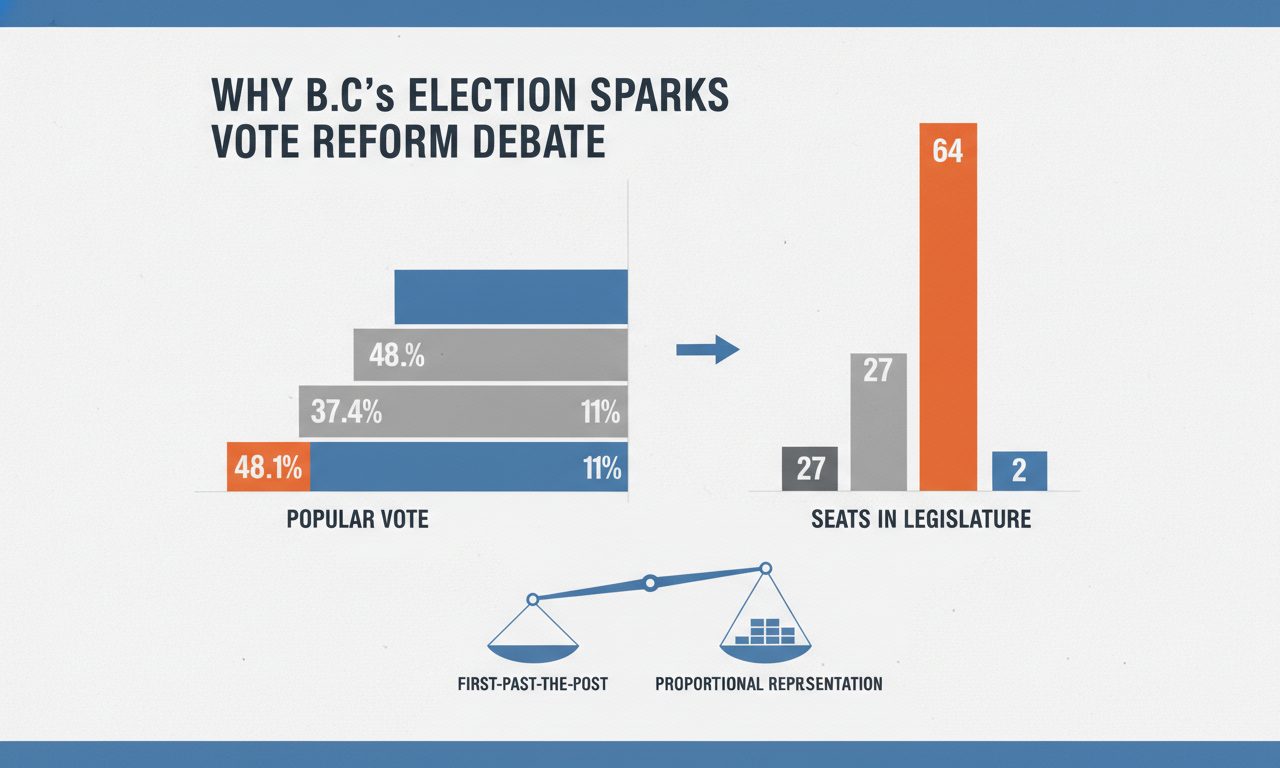
Majority Seat Yield Under First-Past-the-Post
The Oct. 24 British Columbia provincial election concluded with the Conservatives capturing a majority government, securing 64 of the 93 seats in the legislature. The BC New Democratic Party won 27 seats, while the BC Greens won two. However, fewer than half of total voters chose a Conservative candidate, as the party received 48.1 per cent of the popular vote.
By comparison, the BC NDP received 37.4 per cent of the vote, and the BC Greens earned 11 per cent. Additional parties shared the remaining 3.5 per cent of votes, with Centre BC taking 1.6 per cent and OneBC securing 1.5 per cent. Because British Columbia utilizes the first-past-the-post voting system, political parties can secure a majority of legislative seats without obtaining a majority of individual votes.
Advocates Push for Proportional Representation
In response to the outcome, advocacy group Fair Vote Canada renewed its critique of the current electoral model, urging a shift to proportional representation. The organization noted that over 80 per cent of Western democracies employ proportional systems.
“In many countries with proportional representation, cooperation across the aisle is the norm and better long-term outcomes on the economy, health and the environment are the result,” Fair Vote Canada said in a statement. “For the sake of all BC voters, it’s time to put proportional representation back on the agenda.”
Fair Vote Canada pointed to a 2025 poll indicating that 75 per cent of British Columbians back the adoption of a proportional voting model.
Federal Pattern Shows Similar Disparity
Discrepancies between vote share and seat counts also regularly occur in Canadian federal elections. During the 2019 federal election, Justin Trudeau’s Liberals won 157 seats with 33.12 per cent of the vote to form a minority government, despite the Conservatives winning 34.34 per cent of the popular vote and 121 seats.
A similar outcome occurred in 2021 when the federal Liberals retained a minority government by winning 160 seats with 32.62 per cent voter support, while the federal Conservatives won 119 seats with 33.74 per cent of the vote.

Why the Early Election Gamble Backfired on the NDP

Why Fake Signs Targeted a Small Green Party Campaign on B.C. Election Eve

Why the Conservatives’ Majority Win in Kelowna-Mission Signals Big Changes for Local Healthcare and Economy

Why B.C.’s Latest Election Results Are Sparking Renewed Calls for Voting Reform
Your Current 3 Day Forecast — October 27, 2026
Why First Nations Leaders Are Gathering in Ottawa to Push Back on Fast-Tracked Resource Projects

Opinion: John Rustad Has to Go

B.C. Supreme Court Grants Cowichan Tribes Title to Historic Richmond Lands and Fishing Rights

Vancouver Canucks Gear Up for a Make-or-Break 2025–26 Season

BC Ferries Sparks Outcry Over Contract with Chinese Shipyard

Kamloops Blazers Announce Off-Season Changes Ahead of 2025–26 Season

A Taste of Autumn: Fall Okanagan Wine Festival 2025
-
 BC STORIES5 days ago
BC Conservatives Promise Forestry Overhaul to Revive Jobs as NDP Points to Millions in Existing Investment
-

 SPORTS5 days ago
Why B.C. Lions Starters Are Resting as the Regular Season Concludes Against Winnipeg
-
 OPINIONS5 days ago
How Minor Parties and Strategic Balloting Could Shift the Upcoming B.C. Election
-

 BC STORIES6 days ago
Police Seek Witnesses After Fatal Wrong-Way Collision Near Merritt
-
5 days ago
Your Current 3 Day Forecast — October 22, 2026
-
NATIONAL STORIES6 days ago
Highland Valley Copper Workers Could Strike Saturday as Union Issues Notice
-
6 days ago
Your Current 3 Day Forecast — October 21, 2026
-
 HEALTH6 days ago
Coquihalla Highway Reopens Near Merritt Following Morning Crash That Injured Four