POLITICS
Poilievre Unveils ‘Free Nations’ Trade Doctrine in Landmark London Speech
Conservative Leader Pierre Poilievre pitches a ‘free trade between free nations’ doctrine in London, proposing closer ties with the UK, Australia, and New Zealand.


A Shift Toward Strategic Alliances
In a significant pivot to the international stage, Conservative Leader Pierre Poilievre delivered a high-stakes address at the Centre for Policy Studies in London on Tuesday. Speaking as part of the prestigious Margaret Thatcher lecture series, Poilievre articulated a vision of "economic realism" that seeks to redefine Canada’s place in a volatile global market. The speech, marking his first major foreign trip as Leader of the Opposition, signaled a strategic shift toward deepening alliances with "like-minded" democratic nations as a bulwark against rising global protectionism and the influence of authoritarian regimes.
"Canada must become stronger at home so that we have unbreakable leverage abroad. Opening trade with like-minded, free nations will do that," Poilievre told the audience. Drawing on the intellectual traditions of Adam Smith and Winston Churchill, and even invoking the folkloric justice of Robin Hood, Poilievre argued that the current global order requires a return to foundational principles: free trade among nations that share a commitment to the rule of law and democratic governance.
The CANZUK Proposal: A New Economic Bloc
The centerpiece of Poilievre’s address was a bold pitch for a strengthened trading and security relationship between Canada, the United Kingdom, Australia, and New Zealand—a concept often referred to by proponents as CANZUK. Poilievre’s vision goes beyond traditional tariff reductions, proposing a deep integration of labor markets and regulatory frameworks. He suggested the removal of professional barriers to allow highly skilled workers, such as doctors and nurses, to have their credentials recognized across all four nations instantaneously.
Furthermore, the Conservative leader called for a "mutual recognition" model for consumer goods and pharmaceuticals. Under this plan, any product approved as safe for consumption in one of the four partner countries would be automatically cleared for sale in the others. This radical simplification of trade logic aims to reduce the bureaucratic friction that currently hampers mid-sized economies in the face of global giants.
Navigating the ‘Fragmentation’ of Global Trade
While Poilievre’s domestic rhetoric often focuses on "axing the tax" and balancing the budget, his London speech addressed the looming shadow of U.S. protectionism. Though he avoided naming U.S. President Donald Trump directly—a departure from a speech he gave just last week at the Economic Club of Canada—the subtext was clear. Poilievre warned that the "fragmentation" of existing trade treaties is creating a power vacuum that hostile actors are eager to fill.
"Supply chains right now that we took for granted are being interrupted, and when democratic alliances fragment, others fill the vacuum," Poilievre cautioned. "If trusted allies do not tighten their economic and security ties, less trusted powers will shape the rules, control the supply chains and set the terms." By advocating for a "doubling down" on ties with historic allies, Poilievre is positioning himself as a leader who can navigate a post-globalization world where trade is increasingly used as a tool of geopolitical statecraft.
A Tale of Two Diplomatic Missions
Poilievre’s European tour coincides with a high-profile diplomatic push by the current Liberal government. Prime Minister Mark Carney is currently in Australia, following a trade mission to India and a scheduled stop in Japan. The parallel trips highlight a deepening divide in Canadian foreign policy: the government’s focus on the "Indo-Pacific Strategy" versus Poilievre’s emphasis on a "Free Nations" bloc rooted in shared heritage and institutional similarity.
While Carney’s mission is designed to "breathe new life" into broad Pacific relationships and diversify away from China, Poilievre’s approach is more exclusionary, focusing on a tight-knit circle of democratic peers. The Conservative leader’s emphasis on critical mineral extraction and energy cooperation among the four Commonwealth nations suggests a desire to build a self-sustaining supply chain that bypasses more volatile global markets.
Looking Ahead to Germany
The London speech is only the first leg of Poilievre’s international debut. On Wednesday, the Conservative leader departs for Germany, where he is scheduled to meet with business leaders and industrial titans. In Berlin, Poilievre is expected to continue his focus on energy security, likely pitching Canada as a reliable alternative to Russian gas for European allies. As the Canadian federal election looms on the horizon, these international maneuvers serve as a clear signal that the Opposition leader is beginning to draft his own "Canada First" foreign policy—one built on the pillars of democratic solidarity and strategic economic independence.

BC STORIES
Why Fake Signs Targeted a Small Green Party Campaign on B.C. Election Eve
Green Party candidate Tim Binnema reported 100 to 200 fake election signs in Surrey-Fleetwood to Elections BC on the eve of the B.C. provincial election.

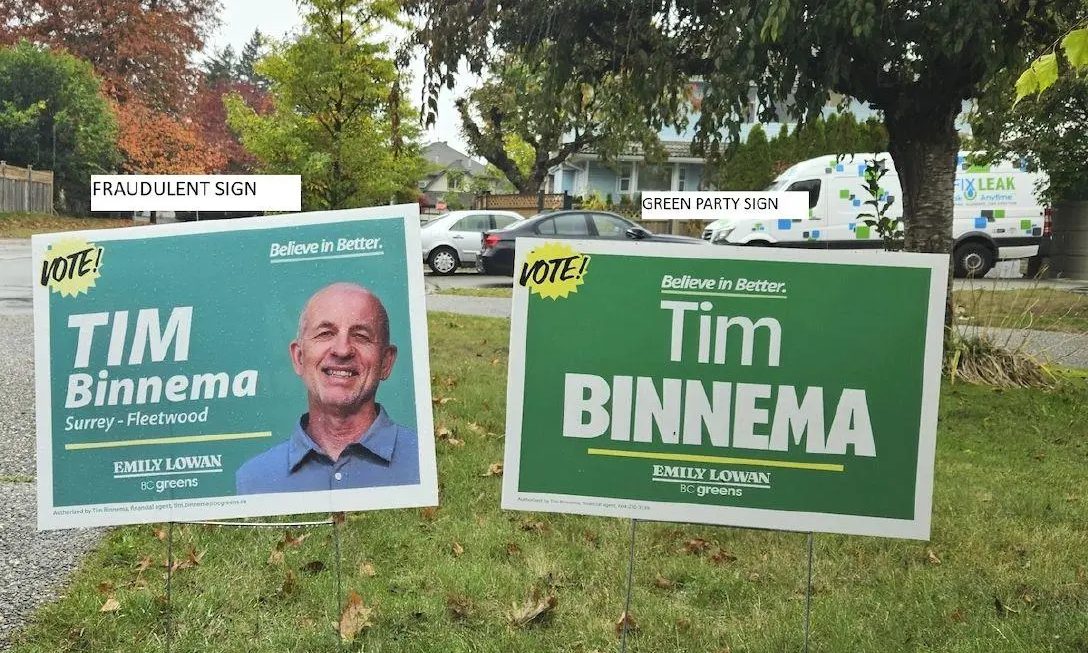
Unauthorized Signage Reported in Surrey-Fleetwood
Elections BC has been notified after between 100 and 200 unauthorized election signs appeared in Surrey-Fleetwood on the eve of the provincial vote. Green Party candidate Tim Binnema discovered the unauthorized material featuring his name and face on Oct. 23, the day before final voting ended.
Binnema, a manager at an engineering firm, noted that the signs contained key discrepancies compared to his official campaign materials. Unlike his legitimate signage, the unauthorized placards displayed his photo, which appeared to be taken directly from his campaign website. The signs also featured an incorrect shade of green and falsely claimed to be authorized by his financial agent.
Potential Vote-Splitting Tactics
The unauthorized placards were discovered near third-party political signs around Surrey and Fleetwood, particularly near 152nd Street and 96th Avenue. Binnema observed that his fake signs were positioned alongside materials expressing opposition to the government, such as “Vote NDP out” and “Why a snap election?” signs, suggesting a deliberate placement pattern.
The riding outcome saw Conservative candidate Garry Purewal secure victory with 8,691 votes, defeating NDP incumbent Jagrup Brar, who received 6,522 votes. Binnema finished in third place with 1,030 votes at the latest tally.
“It was shocking, to tell you the truth. When I turned around the corner and saw my mug (on signs), I thought, ‘Oh my goodness, how did this happen?’” Binnema said, adding that he ran a modest campaign with few signs and feels a responsibility to clear the fraudulent materials.
BC STORIES
Why the Conservatives’ Majority Win in Kelowna-Mission Signals Big Changes for Local Healthcare and Economy
Conservative Gavin Dew wins re-election in Kelowna-Mission as his party secures a majority government in B.C., promising action on healthcare and jobs.

Big Blue Wave Ends Nearly a Decade of NDP Rule
Voters in Kelowna-Mission have chosen incumbent Gavin Dew to return as their MLA, helping propel the Conservative Party to a landslide majority victory across British Columbia on Oct. 24. Over one million voters participated in the election, effectively ending nine years of NDP governance under Premier David Eby, whose decision to call an early fall election backfired.
Dew, who secured nearly 60 per cent of the vote in his riding after first being elected in 2024, celebrated the result alongside family and supporters. He attributed the party’s rapid integration and strong campaign performance to leader Lorne Doerkson, who is projected to become the province’s next premier.
Local Priorities and Economic Focus
With the Conservatives moving from opposition into government, Dew emphasized that his focus will pivot toward delivering tangible improvements. His key local agenda includes opening unused spaces at Kelowna General Hospital, expanding mandatory care programs at Oliver’s Okanagan Correctional Centre, advancing regional transportation projects, and boosting overall economic recovery.
Addressing local economic pressures is a top priority, as Kelowna has recorded the highest unemployment rate among major Canadian cities for five consecutive months. Dew noted that a Conservative administration plans to target growth across key sectors such as tourism, housing, aerospace, and the local wine industry.
Preparing for Governance
Reflecting on the strong mandate received both locally and provincially, Dew expressed optimism as the new Conservative caucus prepares for its initial meetings. He indicated that transitioning into government will allow the party to take direct action on healthcare, public safety, and economic renewal for residents across the province.
BC STORIES
Why B.C.’s Latest Election Results Are Sparking Renewed Calls for Voting Reform
B.C. Conservatives won a majority of seats on Oct. 24 despite getting 48.1% of votes, prompting calls from Fair Vote Canada for voting system reform.
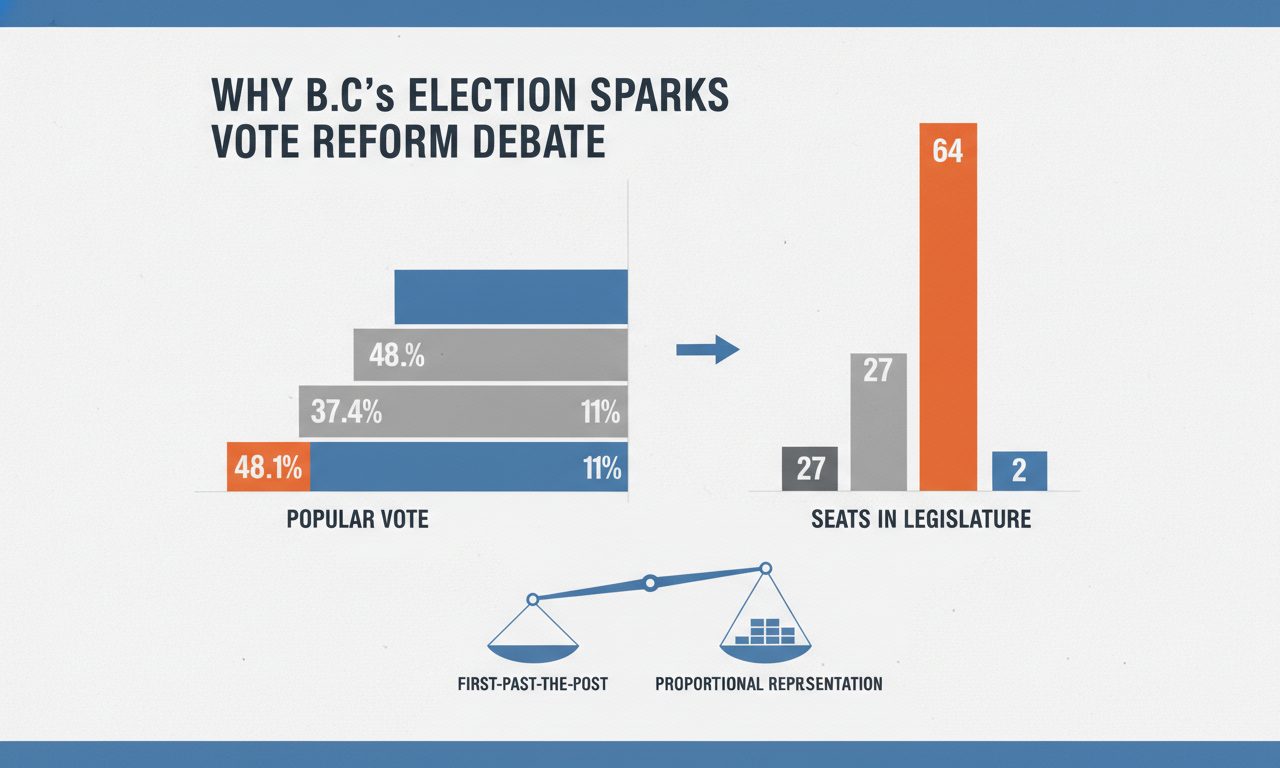
Majority Seat Yield Under First-Past-the-Post
The Oct. 24 British Columbia provincial election concluded with the Conservatives capturing a majority government, securing 64 of the 93 seats in the legislature. The BC New Democratic Party won 27 seats, while the BC Greens won two. However, fewer than half of total voters chose a Conservative candidate, as the party received 48.1 per cent of the popular vote.
By comparison, the BC NDP received 37.4 per cent of the vote, and the BC Greens earned 11 per cent. Additional parties shared the remaining 3.5 per cent of votes, with Centre BC taking 1.6 per cent and OneBC securing 1.5 per cent. Because British Columbia utilizes the first-past-the-post voting system, political parties can secure a majority of legislative seats without obtaining a majority of individual votes.
Advocates Push for Proportional Representation
In response to the outcome, advocacy group Fair Vote Canada renewed its critique of the current electoral model, urging a shift to proportional representation. The organization noted that over 80 per cent of Western democracies employ proportional systems.
“In many countries with proportional representation, cooperation across the aisle is the norm and better long-term outcomes on the economy, health and the environment are the result,” Fair Vote Canada said in a statement. “For the sake of all BC voters, it’s time to put proportional representation back on the agenda.”
Fair Vote Canada pointed to a 2025 poll indicating that 75 per cent of British Columbians back the adoption of a proportional voting model.
Federal Pattern Shows Similar Disparity
Discrepancies between vote share and seat counts also regularly occur in Canadian federal elections. During the 2019 federal election, Justin Trudeau’s Liberals won 157 seats with 33.12 per cent of the vote to form a minority government, despite the Conservatives winning 34.34 per cent of the popular vote and 121 seats.
A similar outcome occurred in 2021 when the federal Liberals retained a minority government by winning 160 seats with 32.62 per cent voter support, while the federal Conservatives won 119 seats with 33.74 per cent of the vote.

Why the Early Election Gamble Backfired on the NDP

Why Fake Signs Targeted a Small Green Party Campaign on B.C. Election Eve

Why the Conservatives’ Majority Win in Kelowna-Mission Signals Big Changes for Local Healthcare and Economy

Why B.C.’s Latest Election Results Are Sparking Renewed Calls for Voting Reform
Your Current 3 Day Forecast — October 27, 2026
Why First Nations Leaders Are Gathering in Ottawa to Push Back on Fast-Tracked Resource Projects

Opinion: John Rustad Has to Go

B.C. Supreme Court Grants Cowichan Tribes Title to Historic Richmond Lands and Fishing Rights

Vancouver Canucks Gear Up for a Make-or-Break 2025–26 Season

BC Ferries Sparks Outcry Over Contract with Chinese Shipyard

Kamloops Blazers Announce Off-Season Changes Ahead of 2025–26 Season

A Taste of Autumn: Fall Okanagan Wine Festival 2025
-
 BC STORIES6 days ago
BC Conservatives Promise Forestry Overhaul to Revive Jobs as NDP Points to Millions in Existing Investment
-

 SPORTS6 days ago
Why B.C. Lions Starters Are Resting as the Regular Season Concludes Against Winnipeg
-

 OPINIONS6 days ago
How Minor Parties and Strategic Balloting Could Shift the Upcoming B.C. Election
-

 BC STORIES6 days ago
Police Seek Witnesses After Fatal Wrong-Way Collision Near Merritt
-
6 days ago
Your Current 3 Day Forecast — October 22, 2026
-
NATIONAL STORIES6 days ago
Highland Valley Copper Workers Could Strike Saturday as Union Issues Notice
-
7 days ago
Your Current 3 Day Forecast — October 21, 2026
-

 HEALTH6 days ago
Coquihalla Highway Reopens Near Merritt Following Morning Crash That Injured Four