POLITICS
The Return of the Center-Right: Inside the Launch of the Progressive Tory Party of Alberta
The Progressive Tory Party of Alberta is officially registered by Elections Alberta. Learn how this new party aims to challenge the UCP and Danielle Smith.


A Strategic Pivot in Alberta’s Political Landscape
In a move that signals a growing fracture within Alberta’s right-wing political landscape, a former member of the United Conservative Party (UCP) caucus has successfully navigated a regulatory minefield to register a new political entity: the Progressive Tory Party of Alberta (PTP). The registration, confirmed this week by Elections Alberta, marks the culmination of a months-long battle over branding, ideological identity, and the right to claim the province’s conservative heritage. This development comes as a direct challenge to the current administration, suggesting that the ‘big tent’ approach of the UCP is beginning to show structural cracks.
The party’s formation comes at a time when Premier Danielle Smith’s government faces increasing scrutiny from both the left and the disaffected right. According to party organizers, the PTP aims to fill a pragmatic void left by the UCP’s shift toward more populist and socially conservative policies. The new party intends to appeal to Red Tories, voters who value fiscal responsibility and private enterprise but maintain more moderate views on social issues, environmental stewardship, and intergovernmental relations. By positioning themselves as a steady alternative, the PTP hopes to attract those who feel the current government has drifted too far from the center-right traditions of past decades.
The Battle Over the Conservative Moniker
Perhaps the most contentious aspect of the party’s inception was the name itself. The provincial government recently saw regulations implemented through Elections Alberta that restricted new political parties from using certain words in their names that might cause voter confusion. Chief among the restricted terms was ‘conservative,’ a move critics argue was a transparent attempt by the UCP to monopolize the brand and prevent any rival from claiming the legacy of the movement. This ban forced organizers to think creatively about their identity.
Organizers initially sought names that included ‘Conservative,’ but were rebuffed by provincial authorities citing the risk of misleading the public. The choice of ‘Progressive Tory’ is both a nod to the historical Progressive Conservative (PC) party that governed Alberta for forty-four consecutive years and a clever workaround to the government’s naming restrictions. By adopting the ‘Tory’ label, the new party seeks to invoke the legacy of former premiers like Peter Lougheed, positioning themselves as the true heirs to Alberta’s traditional center-right governance. They argue that while the word conservative is blocked, the spirit of Toryism remains a foundational pillar of the province’s political identity.
Ideological Foundations and Voter Outreach
The Progressive Tory Party isn’t just about a name; it’s about a perceived lack of representation for moderate Albertans. The founding members, several of whom have ties to the pre-merger PC party, argue that the UCP has moved too far from the principles of evidence-based policy and institutional stability. They point to recent controversies surrounding health care restructuring, the proposed Alberta Pension Plan, and the Sovereignty Act as evidence that the current government is more interested in ideological battles than administrative competence. The PTP platform centers on four main pillars: economic stability, investment in public services, environmental realism, and collaborative federalism.
Albertans are tired of the constant friction with the federal government and the focus on fringe issues, said a spokesperson for the nascent party. There is a silent majority of voters who want a government that balances the books and supports the energy sector but doesn’t feel the need to litigate every social issue or threaten our place within the Canadian federation. This demographic, often referred to as the ‘exhausted middle,’ is the primary target for the PTP as they begin their recruitment efforts in major urban centers like Calgary and Edmonton.
The Road to the 2027 General Election
While the PTP has cleared the significant hurdle of official registration, the path ahead is fraught with challenges. Establishing a grassroots infrastructure, raising funds, and recruiting credible candidates in all eighty-seven ridings is a Herculean task for any new party. Furthermore, the specter of ‘vote splitting’ looms large over the project. In Alberta’s first-past-the-post system, a divided right-wing vote has historically paved the way for the New Democratic Party (NDP), a scenario most conservative voters are desperate to avoid. The UCP has already begun messaging against the new party, labeling it a distraction that only serves the interests of the opposition.
Political analysts suggest that the PTP’s success will depend on its ability to attract high-profile defectors from the UCP and to convince centrist voters that they are a viable alternative to both the UCP and the NDP. With the NDP currently undergoing its own leadership transition, the political center is arguably more contested than ever before. If the PTP can secure even ten percent of the popular vote in key urban ridings, they could become the kingmakers of the 2027 election, forcing a coalition or minority government situation that Alberta has rarely seen in its history.
A Reaction to the UCP’s Populist Turn
The emergence of the PTP is a direct response to the leadership style of Danielle Smith. Since taking the helm of the UCP, Smith has pivoted the party toward a more assertive posture that resonates deeply with her rural base but alienates urban moderates. The PTP hopes to capture these urban voters who are concerned about the government’s stance on the Canada Pension Plan and the perceived instability in the healthcare system. By offering a ‘return to normalcy,’ the Progressive Tory Party is betting that Albertans are ready to trade populist fire for predictable, moderate governance.
As the Progressive Tory Party of Alberta begins its membership drive and prepares for its first policy convention, it remains to be seen if it can transform from a protest movement into a legitimate contender for power. However, its registration alone serves as a reminder that the political landscape in Alberta is shifting once again. The fight for the soul of the province’s right wing is far from over, and the PTP has just fired a significant opening salvo in what promises to be a transformative era for the Wild Rose province.






BC STORIES
Why Fake Signs Targeted a Small Green Party Campaign on B.C. Election Eve
Green Party candidate Tim Binnema reported 100 to 200 fake election signs in Surrey-Fleetwood to Elections BC on the eve of the B.C. provincial election.

Unauthorized Signage Reported in Surrey-Fleetwood
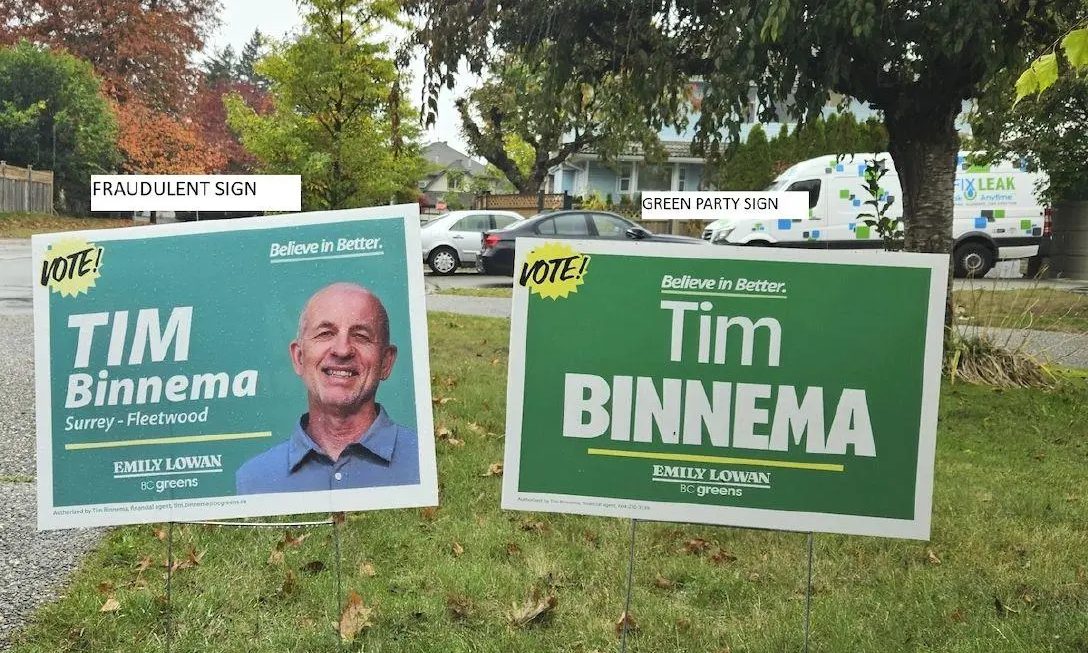
Elections BC has been notified after between 100 and 200 unauthorized election signs appeared in Surrey-Fleetwood on the eve of the provincial vote. Green Party candidate Tim Binnema discovered the unauthorized material featuring his name and face on Oct. 23, the day before final voting ended.
Binnema, a manager at an engineering firm, noted that the signs contained key discrepancies compared to his official campaign materials. Unlike his legitimate signage, the unauthorized placards displayed his photo, which appeared to be taken directly from his campaign website. The signs also featured an incorrect shade of green and falsely claimed to be authorized by his financial agent.
Potential Vote-Splitting Tactics
The unauthorized placards were discovered near third-party political signs around Surrey and Fleetwood, particularly near 152nd Street and 96th Avenue. Binnema observed that his fake signs were positioned alongside materials expressing opposition to the government, such as “Vote NDP out” and “Why a snap election?” signs, suggesting a deliberate placement pattern.
The riding outcome saw Conservative candidate Garry Purewal secure victory with 8,691 votes, defeating NDP incumbent Jagrup Brar, who received 6,522 votes. Binnema finished in third place with 1,030 votes at the latest tally.
“It was shocking, to tell you the truth. When I turned around the corner and saw my mug (on signs), I thought, ‘Oh my goodness, how did this happen?’” Binnema said, adding that he ran a modest campaign with few signs and feels a responsibility to clear the fraudulent materials.
BC STORIES
Why the Conservatives’ Majority Win in Kelowna-Mission Signals Big Changes for Local Healthcare and Economy
Conservative Gavin Dew wins re-election in Kelowna-Mission as his party secures a majority government in B.C., promising action on healthcare and jobs.

Big Blue Wave Ends Nearly a Decade of NDP Rule
Voters in Kelowna-Mission have chosen incumbent Gavin Dew to return as their MLA, helping propel the Conservative Party to a landslide majority victory across British Columbia on Oct. 24. Over one million voters participated in the election, effectively ending nine years of NDP governance under Premier David Eby, whose decision to call an early fall election backfired.
Dew, who secured nearly 60 per cent of the vote in his riding after first being elected in 2024, celebrated the result alongside family and supporters. He attributed the party’s rapid integration and strong campaign performance to leader Lorne Doerkson, who is projected to become the province’s next premier.
Local Priorities and Economic Focus
With the Conservatives moving from opposition into government, Dew emphasized that his focus will pivot toward delivering tangible improvements. His key local agenda includes opening unused spaces at Kelowna General Hospital, expanding mandatory care programs at Oliver’s Okanagan Correctional Centre, advancing regional transportation projects, and boosting overall economic recovery.
Addressing local economic pressures is a top priority, as Kelowna has recorded the highest unemployment rate among major Canadian cities for five consecutive months. Dew noted that a Conservative administration plans to target growth across key sectors such as tourism, housing, aerospace, and the local wine industry.
Preparing for Governance
Reflecting on the strong mandate received both locally and provincially, Dew expressed optimism as the new Conservative caucus prepares for its initial meetings. He indicated that transitioning into government will allow the party to take direct action on healthcare, public safety, and economic renewal for residents across the province.
BC STORIES
Why B.C.’s Latest Election Results Are Sparking Renewed Calls for Voting Reform
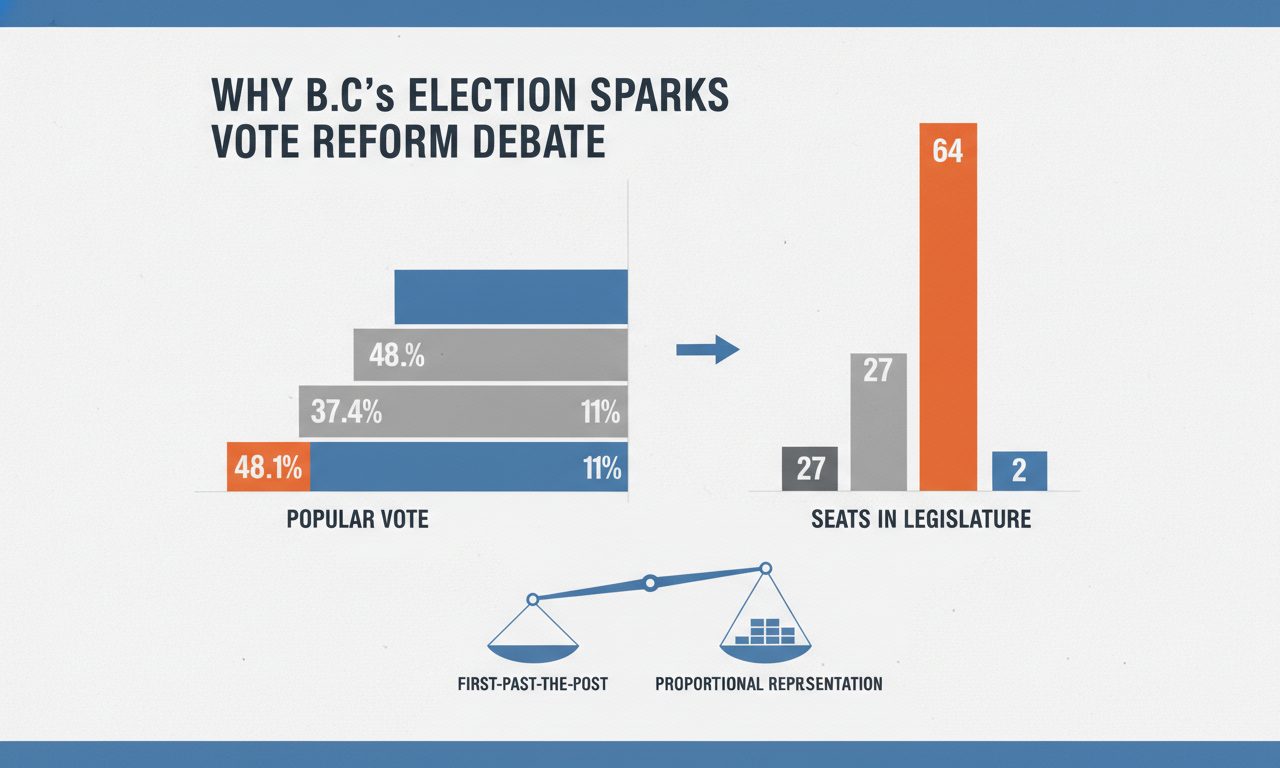
B.C. Conservatives won a majority of seats on Oct. 24 despite getting 48.1% of votes, prompting calls from Fair Vote Canada for voting system reform.
Majority Seat Yield Under First-Past-the-Post
The Oct. 24 British Columbia provincial election concluded with the Conservatives capturing a majority government, securing 64 of the 93 seats in the legislature. The BC New Democratic Party won 27 seats, while the BC Greens won two. However, fewer than half of total voters chose a Conservative candidate, as the party received 48.1 per cent of the popular vote.
By comparison, the BC NDP received 37.4 per cent of the vote, and the BC Greens earned 11 per cent. Additional parties shared the remaining 3.5 per cent of votes, with Centre BC taking 1.6 per cent and OneBC securing 1.5 per cent. Because British Columbia utilizes the first-past-the-post voting system, political parties can secure a majority of legislative seats without obtaining a majority of individual votes.
Advocates Push for Proportional Representation
In response to the outcome, advocacy group Fair Vote Canada renewed its critique of the current electoral model, urging a shift to proportional representation. The organization noted that over 80 per cent of Western democracies employ proportional systems.
“In many countries with proportional representation, cooperation across the aisle is the norm and better long-term outcomes on the economy, health and the environment are the result,” Fair Vote Canada said in a statement. “For the sake of all BC voters, it’s time to put proportional representation back on the agenda.”
Fair Vote Canada pointed to a 2025 poll indicating that 75 per cent of British Columbians back the adoption of a proportional voting model.
Federal Pattern Shows Similar Disparity
Discrepancies between vote share and seat counts also regularly occur in Canadian federal elections. During the 2019 federal election, Justin Trudeau’s Liberals won 157 seats with 33.12 per cent of the vote to form a minority government, despite the Conservatives winning 34.34 per cent of the popular vote and 121 seats.
A similar outcome occurred in 2021 when the federal Liberals retained a minority government by winning 160 seats with 32.62 per cent voter support, while the federal Conservatives won 119 seats with 33.74 per cent of the vote.

Why the Early Election Gamble Backfired on the NDP

Why Fake Signs Targeted a Small Green Party Campaign on B.C. Election Eve

Why the Conservatives’ Majority Win in Kelowna-Mission Signals Big Changes for Local Healthcare and Economy

Why B.C.’s Latest Election Results Are Sparking Renewed Calls for Voting Reform
Your Current 3 Day Forecast — October 27, 2026
Why First Nations Leaders Are Gathering in Ottawa to Push Back on Fast-Tracked Resource Projects

Opinion: John Rustad Has to Go

B.C. Supreme Court Grants Cowichan Tribes Title to Historic Richmond Lands and Fishing Rights

Vancouver Canucks Gear Up for a Make-or-Break 2025–26 Season

BC Ferries Sparks Outcry Over Contract with Chinese Shipyard

Kamloops Blazers Announce Off-Season Changes Ahead of 2025–26 Season

A Taste of Autumn: Fall Okanagan Wine Festival 2025
-
 BC STORIES5 days ago
BC Conservatives Promise Forestry Overhaul to Revive Jobs as NDP Points to Millions in Existing Investment
-

 SPORTS5 days ago
Why B.C. Lions Starters Are Resting as the Regular Season Concludes Against Winnipeg
-

 OPINIONS5 days ago
How Minor Parties and Strategic Balloting Could Shift the Upcoming B.C. Election
-

 BC STORIES6 days ago
Police Seek Witnesses After Fatal Wrong-Way Collision Near Merritt
-
5 days ago
Your Current 3 Day Forecast — October 22, 2026
-
6 days ago
Your Current 3 Day Forecast — October 21, 2026
-
NATIONAL STORIES6 days ago
Highland Valley Copper Workers Could Strike Saturday as Union Issues Notice
-

 HEALTH6 days ago
Coquihalla Highway Reopens Near Merritt Following Morning Crash That Injured Four