Military
Mideast Conflict Escalates: U.S. and Iran Trade Heavy Fire as Peace Talks Falter
U.S. and Iran launch reciprocal airstrikes as President Trump warns of further escalation. Global oil prices surge to $92 a barrel amid stalled peace talks.


Rising Tensions and Direct Military Confrontation
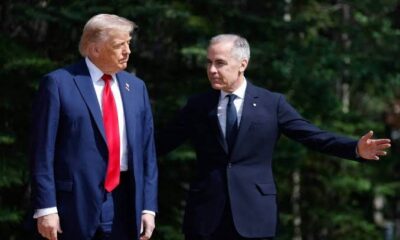
The Middle East has entered a dangerous new phase of escalation as the United States and Iran launched a series of reciprocal military strikes on Wednesday. President Donald Trump, speaking from the White House, confirmed that U.S. forces targeted Iranian military infrastructure, including air defense systems and surveillance radar sites. The strikes follow a wave of Iranian attacks on Bahrain, Kuwait, and Jordan—nations that currently host American military personnel.
The military activity further intensified on the high seas. U.S. Central Command reported that an American aircraft disabled the Palau-flagged oil tanker M/T Settebello in the Gulf, marking the eighth vessel neutralized under the current blockade. While the U.S. maintains these actions are necessary to enforce sanctions and prevent the transport of Iranian oil, the incident has drawn international concern after India’s Foreign Ministry reported three crew members missing following the strike.
The Stalled Path to Peace
Despite the military exchange, diplomatic channels remain tentatively open, though the rhetoric is hardening. President Trump warned that Tehran would ‘pay the price’ for what he characterized as stalling tactics in peace negotiations. ‘We were really close to a deal, but they keep tapping us along,’ Trump told reporters, emphasizing his willingness to increase military pressure if a final agreement is not reached immediately. The U.S. is currently demanding that Iran surrender its stockpile of highly enriched uranium, a condition Tehran has so far rejected.
In response, Iranian Foreign Ministry spokesperson Esmail Baghaei stated that the recent American attacks would force the Islamic Republic to ‘review its stance’ on the ongoing negotiations. While a Qatari delegation has arrived in Tehran to mediate, the gap between the two sides remains wide, particularly regarding the release of frozen Iranian assets and the lifting of economic sanctions.
Global Economic Fallout
The conflict’s expansion is being felt far beyond the borders of the Middle East. Global energy markets reacted sharply to the news, with crude oil prices surging above $92 a barrel—a 25 percent increase since the war began in late February. The instability in the Strait of Hormuz, a vital artery for global energy supplies, continues to drive up costs for food and basic goods worldwide, complicating the political landscape as the U.S. moves closer to congressional elections.


International Relations
Trump Issues Lethal Force Authorization Against Iranian Vessels in Strait of Hormuz
President Trump authorizes the U.S. Navy to use lethal force against Iranian small boats in the Strait of Hormuz following increased maritime tensions.

Heightened Tensions in the Persian Gulf
In a significant escalation of maritime tensions, President Donald Trump has issued a direct order to the United States military to engage and destroy Iranian small boats that harass American vessels in the Strait of Hormuz. The directive, announced via social media, comes on the heels of reports that Iranian forces seized another tanker allegedly involved in the smuggling of Iranian oil, further destabilizing one of the world’s most critical energy transit corridors.
New Rules of Engagement
The President’s instruction to “shoot and kill”—a term interpreted in naval contexts as a mandate to neutralize or destroy hostile threats—represents a hardening of the United States’ posture toward the Islamic Revolutionary Guard Corps (IRGC). For years, Iranian fast-attack craft have utilized swarming tactics to shadow and intimidate international warships and commercial tankers. While the U.S. Navy has traditionally exercised restraint to avoid accidental conflict, this new executive mandate signals a shift toward immediate kinetic response if American assets are obstructed or harassed.
The Strategic Importance of Hormuz
The Strait of Hormuz remains a primary geopolitical flashpoint, as approximately one-fifth of the world’s oil passes through the narrow waterway. Any military confrontation in these waters carries the potential to disrupt global energy markets and trigger a broader regional conflict. Analysts suggest that the timing of this order is intended to deter further Iranian interference with commercial shipping following the recent seizure of vessels associated with sanctioned oil smuggling operations.
Military and Diplomatic Repercussions
Pentagon officials are expected to clarify how this directive will be integrated into existing maritime Rules of Engagement. While the President’s rhetoric is clear, the practical application on the water requires a delicate balance between defense and escalation. As the U.S. military prepares to enforce this mandate, the international community remains on high alert for potential retaliatory actions from Tehran, which has historically viewed the presence of Western naval forces in the Gulf as a direct provocation.
Legal
Australia’s Most Decorated Veteran Ben Roberts-Smith Charged with War Crime Murders
Ben Roberts-Smith, Australia’s most decorated living soldier, has been charged with five counts of war crime murder relating to his service in Afghanistan.

Historic Charges Filed Against Victoria Cross Recipient
In a landmark development for Australian military justice, former Special Air Service (SAS) corporal Ben Roberts-Smith was arrested and charged on Tuesday with five counts of war crime murder. The 47-year-old, who remains Australia’s most decorated living veteran, was taken into custody at Sydney Airport following his arrival from Brisbane. The charges stem from allegations involving the intentional killing of five unarmed Afghan non-combatants during his service between 2009 and 2012.
Allegations of Misconduct in Conflict Zones
Australian Federal Police (AFP) Commissioner Krissy Barrett detailed the gravity of the allegations, stating that the victims were not participating in hostilities at the time of their deaths. According to the prosecution, the victims were detained and under the control of Australian Defence Force (ADF) members when they were killed. It is further alleged that Roberts-Smith either personally shot the victims or ordered subordinates to do so in his presence. If convicted, the charge of war crime murder carries a potential sentence of life imprisonment under Australian federal law.
From Civil Defamation to Criminal Prosecution
The criminal charges follow a high-profile civil defamation case initiated by Roberts-Smith against several media outlets in 2018. In 2023, a federal judge dismissed the suit, ruling that the newspapers had proven to a civil standard that Roberts-Smith likely unlawfully killed four Afghans. However, the upcoming criminal proceedings will require a higher burden of proof—beyond a reasonable doubt—to secure a conviction. The investigation into these incidents was facilitated by the Office of the Special Investigator, which was established following a 2020 military report that uncovered evidence of systemic unlawful killings by elite Australian troops.
A Turning Point for the ADF
Roberts-Smith is the second Australian veteran to face such charges related to the Afghanistan campaign, following the arrest of former soldier Oliver Schulz. Between 2001 and 2021, approximately 40,000 Australian personnel served in Afghanistan. The ongoing legal actions represent a significant moment for the nation as it grapples with the legacy of its longest war and the conduct of its most elite fighting forces. Investigative journalists expect former SAS colleagues to testify, many of whom have previously spoken out about the moral and legal challenges they faced while serving alongside the accused.

What the City of Vernon’s Decision to Cut Ties Means for Historic O’Keefe Ranch

Police Request Public Help After Fatal Highway 93 Crash Kills Local Resident

Why an Attempted Cannabis Smuggling Trip to London Led to Jail Time for an Ontario Man

Why Okanagan Pet Owners Turned to Free BC SPCA Clinics After Wildfire Season
Your Current 3 Day Forecast — October 6, 2026

BC Lions Hold Off Toronto Argonauts Behind Sean Whyte’s Record Eight Field Goals

Opinion: John Rustad Has to Go

B.C. Supreme Court Grants Cowichan Tribes Title to Historic Richmond Lands and Fishing Rights

Vancouver Canucks Gear Up for a Make-or-Break 2025–26 Season

Kamloops Blazers Announce Off-Season Changes Ahead of 2025–26 Season

BC Ferries Sparks Outcry Over Contract with Chinese Shipyard

A Taste of Autumn: Fall Okanagan Wine Festival 2025
-

 OPINIONS6 days ago
B.C.’s 93-Riding Scramble: Can the Parties Even Find Enough Candidates?
-

 BC STORIES4 days ago
Why OneBC’s Interim Leader Is Proposing an Election Pact With Conservatives
-

 BC STORIES6 days ago
BC Greens Pledge Free Childcare by 2031 and Introduce Victoria-Swan Lake Candidate
-
 NATIONAL STORIES6 days ago
Will they use Chinese Steel over Canadian like Phase One?
-
SPORTS4 days ago
Maple Leafs vs Islanders Result: Easton Cowan Scores in 2-1 Win
-
NATIONAL STORIES5 days ago
Why a Canadian Nationalist Group’s Hidden Recruitment Practices Are Drawing Scrutiny
-

 NATIONAL STORIES4 days ago
Why NDP Leader Avi Lewis Says the West Coast Pipeline Plan Risks Public Funds
-
SPORTS5 days ago
Why the Edmonton Oilers Will Be Without Ryan Nugent-Hopkins Against Vancouver