LOCAL
Eyes in Your Ears: How Apple’s Upcoming AirPods Pro with IR Cameras Will Change Everything
Apple’s next AirPods Pro are rumored to feature IR cameras for Visual Intelligence and Spatial Audio. Discover how these sensors will transform Apple’s wearables.


A New Era for Personal Audio
For years, the evolution of the Apple AirPods Pro has been defined by incremental improvements in active noise cancellation, battery life, and acoustic transparency. However, a new wave of industry reports suggests that Apple is preparing for a radical shift in how we perceive and interact with its most popular wearable. The upcoming generation of AirPods Pro, widely expected to debut as early as this year, is rumored to feature integrated infrared (IR) cameras, transforming the earbuds from mere audio drivers into sophisticated sensory tools for the era of artificial intelligence.
The Leak: ‘Next AirPods Pro Can See Around You’
The buzz surrounding these hardware changes intensified recently when noted leaker Kosutami shared a brief but provocative post on X (formerly Twitter). The post claimed that the next iteration of the AirPods Pro would be able to “see around you,” effectively confirming that imaging sensors are the primary hardware focus for the next update. While Apple has historically maintained a three-year refresh cycle for the Pro lineup, these rumors suggest the company may be moving faster to align its hardware with its aggressive rollout of Apple Intelligence.
Understanding the Technology: IR Cameras vs. Traditional Lenses
It is important to note that these are not standard video cameras designed to capture photos or 4K video. Instead, according to veteran analyst Ming-Chi Kuo, Apple is opting for infrared camera modules. This technology is more akin to the Face ID hardware found on the iPhone than a traditional camera. By using multiple light sources to map depth and distance, these sensors allow the device to build a mathematical model of the user’s environment.
This hardware implementation serves several purposes. Primarily, it is designed to enhance the Spatial Audio experience, particularly when used in conjunction with the Apple Vision Pro. By mapping the room in real-time, the AirPods can calibrate audio reflections and positioning with surgical precision, ensuring that sound remains anchored in the physical world even as the user moves.
The Visual Intelligence Connection
Beyond audio, the addition of IR sensors acts as a data pipeline for ‘Visual Intelligence,’ a feature Apple CEO Tim Cook has recently touted as a cornerstone of the company’s AI future. While the iPhone 16 uses its primary camera for visual search and object identification, the AirPods Pro could provide a constant, low-power stream of environmental data. This would allow the Apple Intelligence ecosystem to understand the context of where a user is and what they are looking at without the user ever needing to take their phone out of their pocket.
Design Consistency and Pricing Strategy
Despite the high-tech internal upgrades, reports suggest that Apple will maintain the external aesthetic of the current AirPods Pro. The goal appears to be a seamless integration of the sensors into the existing white stems. There is significant debate regarding the price point; while some leakers suggest Apple will keep the current pricing, others point to the recent AirPods 4 launch as a potential template. Apple may offer a two-tier Pro lineup: a standard high-fidelity model and a premium ‘Vision-Ready’ model featuring the new IR camera array.
Looking Toward the Horizon
While Apple typically reserves its major hardware announcements for its annual September iPhone event, the rapid development of its AI software suite could move the timeline forward. Whether these new AirPods arrive in late 2024 or early 2025, they represent a significant step in Apple’s quest to dominate the ‘ambient computing’ market. By putting ‘eyes’ in our ears, Apple is not just changing how we listen to music—it is changing how our digital assistants see the world we live in.

LOCAL
Community Safety Highlighted After Gunshots Hit Fort St. John Home
Fort St. John RCMP are investigating after gunshots struck a home on Saturday. Police confirm no injuries were reported in the residential incident.

RCMP Respond to Shooting in Residential Area
An investigation is underway in Fort St. John, B.C., after a local home was struck by gunfire on Saturday.
RCMP officers were dispatched to the neighborhood following multiple public reports of gunshots. Upon arrival, police confirmed that a residence had been hit several times.
Police Warn of Danger to Neighbourhood
No injuries were reported as a result of the gunfire. However, law enforcement officials emphasized the severe potential risks associated with the incident.
“Cpl. Brett Urano says it was fortunate no one was injured, but the potential for a tragic outcome can’t be understated,” police stated. Officials added that discharging firearms in a residential area puts innocent individuals and families at serious risk.
LOCAL
Suspect Arrested in North Kelowna Hit-and-Run After Multi-Unit RCMP Search
Kelowna and Lake Country RCMP arrested a hit-and-run suspect after a two-vehicle crash on Highway 97 near Ellison Lake on Oct. 24. No injuries reported.
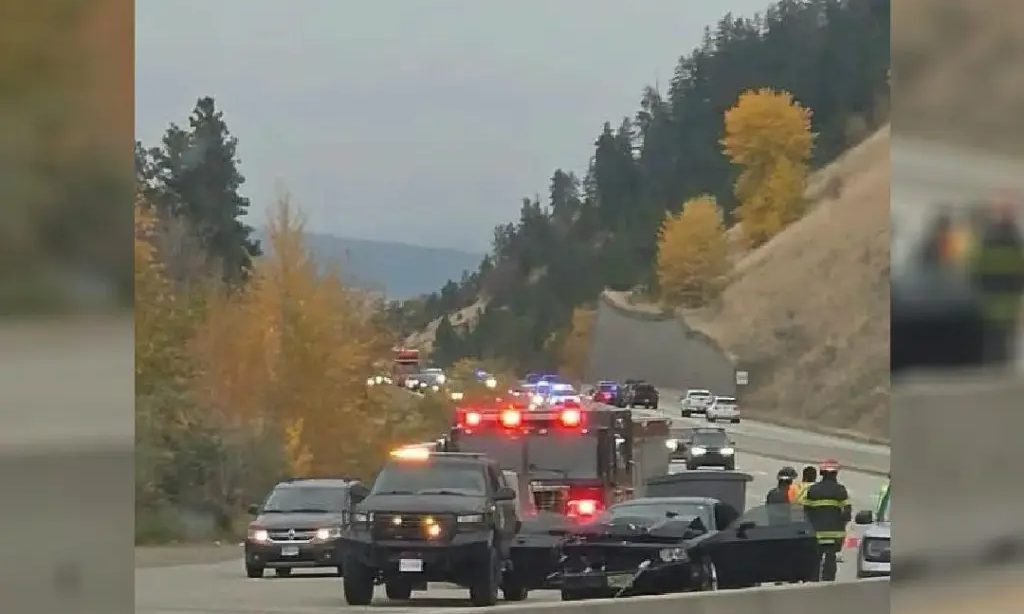
Hit-and-Run Incident Causes Traffic Delay on Highway 97
A driver attempting to flee on foot following a two-vehicle crash on Highway 97 near Ellison Lake was taken into custody by police on Saturday, Oct. 24. The collision in North Kelowna resulted in traffic slowing to a crawl while emergency responders managed the scene.
Extensive Police Response Leads to Arrest
Witnesses contacted authorities after observing the driver of a black sedan abandon the vehicle and run into a nearby green space. Multiple law enforcement teams were dispatched to track down the fleeing suspect, including the Kelowna RCMP Road Safety Unit, the Kelowna RCMP Gang Enforcement Team, frontline officers, Lake Country RCMP, Police Dog Services, and RCMP Air Services.
According to Kelowna RCMP media relations officer Cpl. Steven Lang, officers located and arrested the suspected driver close to the crash site shortly after the search began.
Police Investigation Ongoing
Authorities reported that no injuries occurred as a result of the collision. “Investigators believe alcohol and speed were factors in the collision,” Lang stated.
HEALTH
Coquihalla Highway Reopens Near Merritt Following Morning Crash That Injured Four
The Coquihalla Highway north of Merritt has reopened following a Saturday morning vehicle crash that resulted in four people being taken to the hospital.

Traffic Resumes Following Serious Morning Incident
Four people were hospitalized, including three in critical condition, after a motor vehicle incident occurred north of Merritt on Saturday morning, October 17.
DriveBC reported that the Coquihalla Highway was reopened in both directions from Exit 290 to Exit 315 at approximately 4:00 p.m., following the earlier closure.
Emergency Responders Deploy Air Ambulances
BC Emergency Health Services dispatched multiple resources after receiving a call at approximately 8:35 a.m. The response included two air ambulances, three primary care paramedic ambulances, one advanced care paramedic ambulance, and a paramedic supervisor.
According to BCEHS, crews provided emergency medical care at the scene. Two of the three critically injured patients were flown to the hospital via air ambulance, while a fourth patient was taken to the hospital in stable condition.

Why the Early Election Gamble Backfired on the NDP

Why Fake Signs Targeted a Small Green Party Campaign on B.C. Election Eve

Why the Conservatives’ Majority Win in Kelowna-Mission Signals Big Changes for Local Healthcare and Economy

Why B.C.’s Latest Election Results Are Sparking Renewed Calls for Voting Reform
Your Current 3 Day Forecast — October 27, 2026
Why First Nations Leaders Are Gathering in Ottawa to Push Back on Fast-Tracked Resource Projects

Opinion: John Rustad Has to Go

B.C. Supreme Court Grants Cowichan Tribes Title to Historic Richmond Lands and Fishing Rights

Vancouver Canucks Gear Up for a Make-or-Break 2025–26 Season

BC Ferries Sparks Outcry Over Contract with Chinese Shipyard

Kamloops Blazers Announce Off-Season Changes Ahead of 2025–26 Season

A Taste of Autumn: Fall Okanagan Wine Festival 2025
-

 BC STORIES5 days ago
BC Conservatives Promise Forestry Overhaul to Revive Jobs as NDP Points to Millions in Existing Investment
-

 SPORTS5 days ago
Why B.C. Lions Starters Are Resting as the Regular Season Concludes Against Winnipeg
-

 OPINIONS5 days ago
How Minor Parties and Strategic Balloting Could Shift the Upcoming B.C. Election
-
 BC STORIES6 days ago
Police Seek Witnesses After Fatal Wrong-Way Collision Near Merritt
-
5 days ago
Your Current 3 Day Forecast — October 22, 2026
-
NATIONAL STORIES6 days ago
Highland Valley Copper Workers Could Strike Saturday as Union Issues Notice
-
6 days ago
Your Current 3 Day Forecast — October 21, 2026
-

 HEALTH6 days ago
Coquihalla Highway Reopens Near Merritt Following Morning Crash That Injured Four