COMMUNITY
The week ahead in West Coast: Mon 24 — Sun 30 August
7 things to do in West Coast, Mon 24 — Sun 30 August.

The West Coast Current · What’s on
The week ahead
Mon 24 — Sun 30 August
Seven days of what’s on, and what to keep an eye on.
The week at a glance Mon 24 — Sun 30 August
1 pm Child & Family Wellness Drop-In Child & Family Wellness at The ʔumʔiiqsu Center, 4305 Kendall Avenue, Port Alberni 3 pm Youth Center (Ages 9-17) Somass Hall (Lower Level), 6200 Gallic Rd 7:30 pm Monday Night Movies Clayoquot Sound Community Theatre
4 pm Vancouver General Food Fish Distribution Vancouver Aboriginal Mother Center, 2019 Dundas St., Vancouver 6:30 pm Language Class Tseshaht Language House
What’s on 7 events
Child & Family Wellness Drop-In
- Time
- 1 pm
- Where
- Child & Family Wellness at The ʔumʔiiqsu Center, 4305 Kendall Avenue, Port Alberni
ʔaaqinʔaƛḥak (Au-khin utl ḥak – How are you doing?
Youth Center (Ages 9-17)
- Time
- 3 pm
- Where
- Somass Hall (Lower Level), 6200 Gallic Rd
Vancouver General Food Fish Distribution
- Time
- 4 pm
- Where
- Vancouver Aboriginal Mother Center, 2019 Dundas St., Vancouver
𝐕𝐚𝐧𝐜𝐨𝐮𝐯𝐞𝐫 𝐖𝐡𝐞𝐧: Tuesday, August 25, 2026 𝐆𝐞𝐧𝐞𝐫𝐚𝐥 𝐃𝐢𝐬𝐭𝐫𝐢𝐛𝐮𝐭𝐢𝐨𝐧: 4 – 6 p. m.
Youth Center (Ages 9-17)
- Time
- 3 pm
- Where
- Somass Hall (Lower Level), 6200 Gallic Rd
Also coming up 8 of 81
- Mon, Aug 31 Overdose Awareness Day
- Mon, Aug 31 Child & Family Wellness Drop-In
- Mon, Aug 31 Youth Center (Ages 9-17)
- Tue, Sep 1 Language Class
- Wed, Sep 2 Youth Center (Ages 9-17)
- Fri, Sep 4 Friday Beverage Gardens Sponsored by Port Boat House
- Fri, Sep 4 Mixed Signals
- Fri, Sep 4 Noise Machine
Dates and names only — we confirm the details with each organiser in the edition that runs them.
Running something? Get it in front of your neighbours.
The West Coast Current publishes this every week for readers looking for something to do. Listing is free, and what you send us is what runs — so check the details before you send them. Or post it to your municipal calendar and we will find it.





BC STORIES
B.C. Faces an Early and Hard-Hitting Flu Season as Symptoms Intensify
B.C. flu season arrives early as Health Canada reports elevated activity. Learn about the dominant H1N1 strain, severe symptoms, and vaccine availability.


Early Arrival and Severe Symptoms
Influenza activity in British Columbia has surged earlier than usual this year, bringing illness that health professionals describe as particularly intense. According to Health Canada data, flu test positivity across the province is running above average for this time of year, departing from the typical pattern where cases climb slowly toward a holiday peak.
Pharmacists note that the current wave is taking a heavier toll on patients compared to last year. Pharmasave pharmacist Fairuz Siraj stated, “This year it’s hitting hard. We’re seeing a lot of cases of people coming down, feeling ill, and taking more time to recover. A lot more severe type of illness than what we saw last year.”
Dominant Strain and Vaccine Alignment
Data from the Public Health Agency of Canada and the BC Centre for Disease Control show that B.C. registered a “moderate” flu activity level during the first week and a half of October, with wastewater indicators rising at multiple monitoring locations. Meanwhile, other Canadian provinces continue to report “low” or “very low” activity.
The dominant virus strain in circulation is H1N1, a form of Influenza A. On Oct. 7, B.C. Provincial Health Officer Dr. Bonnie Henry announced the launch of the provincial vaccination campaign 10 days ahead of the usual schedule. Because scientists anticipated that H1N1 would lead cases this season, the current vaccine was formulated specifically to target it. Dr. Brian Ward, a scientist at the McGill University Health Centre, noted that “so far, so good,” though he cautioned that flu viruses can mutate as the season progresses. Ward added it remains too early to know if mid-season mutations will occur and stated he is unaware of any predicted mutations that would reduce vaccine efficacy.
Vaccine Access Details
Free influenza immunizations are currently accessible to B.C. seniors and individuals in high-risk categories. Siraj advised that members of the general public seeking early protection may check walk-in clinics for availability or wait for their individual booking notification links, which are expected in late October or early November.
COMMUNITY
Vancouver Canucks Honour Beloved Broadcaster John ‘Cheech’ Garrett During Home Game
The Vancouver Canucks celebrated the life and career of former goaltender and broadcaster John ‘Cheech’ Garrett during a home game against Carolina.
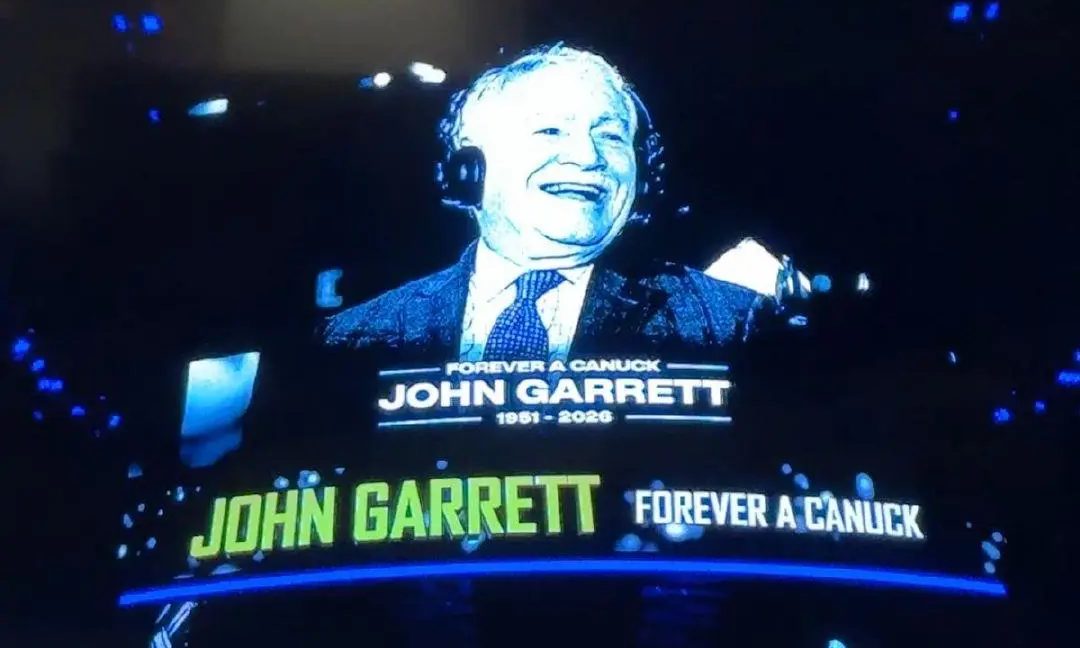
Canucks Wear Memorial T-Shirts and Show Jumbotron Tribute
Vancouver Canucks players and coaching staff wore specialized memorial T-shirts depicting John “Cheech” Garrett’s iconic moustache and broadcast headset prior to Tuesday night’s matchup against the Carolina Hurricanes at Rogers Arena. The Oct. 20 pre-game ceremony featured a video highlighting Garrett’s hockey and broadcasting career on the arena jumbotron before the national anthems.
“John Garrett greeted every day with an optimistic smile, always had time for an autograph, a selfie, and a story to share with his thousands of fans and friends across the hockey world,” announced Al Murdoch, the in-arena voice of the Canucks. In addition to the pre-game video, in-game activities featured trivia focused on Garrett as well as a “hot dog drop.”
A Storied Career On and Off the Ice
Garrett, who resided in the Boundary Park neighbourhood of Surrey, passed away suddenly last April at age 74. Known for his technical hockey insights, signature sense of humour, and enthusiasm for ketchup-topped food, he remained a prominent Sportsnet analyst until his death.
Born in Trenton, Ontario, on June 17, 1951, Garrett was selected 38th overall in the 1971 draft. He competed in the World Hockey Association from 1973 until 1979 before spending 1979 to 1985 in the NHL as a goaltender for several franchises, including the Canucks and the Hartford Whalers. Over his 207 NHL games, he earned a spot in the 1983 All-Star Game and notably recorded the secondary assist on Gordie Howe’s final career NHL goal. Following his playing career, he transitioned directly into broadcasting at Rogers Arena.
Game Outcome
The visiting Carolina Hurricanes, the defending Stanley Cup champions who formerly played as the Hartford Whalers, secured a 6-3 victory over Vancouver following the tributes.
COMMUNITY
The week ahead in West Coast: Mon 19 — Sun 25 October
8 things to do in West Coast, Mon 19 — Sun 25 October.

The West Coast Current · What’s on
The week ahead
Mon 19 — Sun 25 October
Seven days of what’s on, and what to keep an eye on.
The week at a glance Mon 19 — Sun 25 October
10:30 am Anacla Mens Group Soaring Eagle, Lower, Anacla 3 pm Anacla Womens Groups House of Huu-ay-aht 6 pm Anacla Culture Night House of Huu-ay-aht 7:30 pm Monday Night Movies Clayoquot Sound Community Theatre
Nothing yet
11 am October čiyaaqumł (The Fish Cutting Moon) Journal Decorating Circle Soaring Eagle, Lower, Anacla 5 pm Port Alberni Food Fish Distribution Dry Creek Park, 3501 The Quadrant, Port Alberni
Nothing yet
Nothing yet
Nothing yet
What’s on 8 events
Anacla Mens Group
- Time
- 10:30 am
- Where
- Soaring Eagle, Lower, Anacla
huuʕiiʔatḥaḥ (I am a Huu-ay-aht Man). Join us on Monday, October 19, from 10:30 a. m. – 12 p. m. , at the Soaring Eagle in Anacla.
Anacla Womens Groups
- Time
- 3 pm
- Where
- House of Huu-ay-aht
huuʕiiʕaqsumaḥ (I am a Huu-ay-aht Woman). Join us on Monday, October 19, from 3 – 5 p. m. , at the House of Huu-aya-ht in Anacla.
Anacla Culture Night
- Time
- 6 pm
- Where
- House of Huu-ay-aht
éayaakin nuuk (We have lots of songs). Join us on Monday, October 5, 19, & 26, from 6 – 8 p.m., at the House of Huu-ay-aht in Anacla.
October čiyaaqumł (The Fish Cutting Moon) Journal Decorating Circle
- Time
- 11 am
- Where
- Soaring Eagle, Lower, Anacla
t̓iqʷasʔin (To sit together). Nuu-chah-nulth Tribal Council (NTC) is hosting an upcoming čiyaaqumł (The Fish Cutting Moon) Journal Decorating Circle!
Port Alberni Food Fish Distribution
- Time
- 5 pm
- Where
- Dry Creek Park, 3501 The Quadrant, Port Alberni
ʔuucaaqaʔaqƛaḥ saamin (I’ll cook fresh fish). Port Alberni Huu-ay-aht Citizens. Your Distribution is happening on Wednesday, October 21!
Port Alberni Culture Night
- Time
- 2:30 pm
- Where
- Alberni Valley United Church, 3747 Church St, Port Alberni
Alberni Valley United Church, 3747 Church St., Port Alberni, BC 2:30 – 5 p.m. Sundays Bring your shawls and drums!
Punk on Port Alberni at The Capitol Theatre
- Time
- 6 pm
- Where
- The Capitol Theatre, 4904 Argyle St, Port Alberni
Halloweens so nice you might as well do it twice!
Also coming up 8 of 16
- Mon, Oct 26 Anacla Culture Night
- Wed, Oct 28 SAVE THE DATE 2026 Health Ability Fair
- Wed, Oct 28 Port Alberni Mens Group
- Fri, Nov 6 Tofino Community Hall Kitchen Grand Opening
- Fri, Nov 13 Pen Pals
- Fri, Nov 20 Information Session for 2026 People’s Assembly
- Fri, Nov 20 Tofino Winter Nights
- Fri, Nov 20 NEDC BUSINESS AWARDS
Dates and names only — we confirm the details with each organiser in the edition that runs them.
Running something? Get it in front of your neighbours.
The West Coast Current publishes this every week for readers looking for something to do. Listing is free, and what you send us is what runs — so check the details before you send them. Or post it to your municipal calendar and we will find it.
What 5 Neurologist Resignations Mean for Regional Health Care at Interior Health

B.C. Faces an Early and Hard-Hitting Flu Season as Symptoms Intensify
Why David Eby Called a Snap Election Becomes a Campaign Debate Issue
Your Current 3 Day Forecast — October 24, 2026

Why Canada’s Bid for a Turkish Nuclear Deal Is Gaining Ground

BC Voters Prepare to Cast Ballots as Tight Provincial Election Campaign Reaches Its Final Day

Opinion: John Rustad Has to Go

B.C. Supreme Court Grants Cowichan Tribes Title to Historic Richmond Lands and Fishing Rights

Vancouver Canucks Gear Up for a Make-or-Break 2025–26 Season

BC Ferries Sparks Outcry Over Contract with Chinese Shipyard

Kamloops Blazers Announce Off-Season Changes Ahead of 2025–26 Season

A Taste of Autumn: Fall Okanagan Wine Festival 2025
-

 BC STORIES6 days ago
Grassroots Effort and Digital Content Help Deliver Strong Election Finish for Young Candidates
-

 BC STORIES6 days ago
Voters Shift Strategy as Pete Fry Wins Vancouver Mayoral Race
-

 BC STORIES6 days ago
Why B.C. NDP Leader David Eby Is Urging Green Voters to Help Stop a Conservative Win
-

 COMMUNITY5 days ago
The week ahead in West Coast: Mon 19 — Sun 25 October
-
BC STORIES6 days ago
What the B.C. Conservatives’ New Platform Means for Your Taxes and Provincial Services
-
6 days ago
Your Current 3 Day Forecast — October 18, 2026
-
NATIONAL STORIES6 days ago
Tragedy at CFB Wainwright frames last-minute calls for unity as Albertans prepare for referendum vote
-
BC STORIES5 days ago
How B.C.’s Political Parties Plan to Handle the Rise of AI Data Centres