LOCAL
Why Canadians Are Willing to Pay More and Give Up US Travel in Growing Consumer Boycott
Canadians are boycotting US goods, tech, and travel in response to tariffs and trade tensions, shifting to local alternatives despite rising costs.


Citizens Absorb Higher Costs to Support Domestic Alternatives
Everyday spending habits across Canada are undergoing a significant shift as citizens actively avoid American products, tech platforms, and travel. A recent callout by the Guardian drew over 3,500 responses detailing how individuals are altering their daily routines in response to political and economic tensions with the US.
For some, the decision comes with direct financial trade-offs. William McDonald, a 38-year-old diesel mechanic in Thunder Bay, Ontario, noted that choosing domestic options over US goods has pushed his weekly expenses higher. “As soon as Trump started putting those tariffs on in February [last year], I started boycotting US goods,” he said. “Avoiding American products has driven my costs up, and I’m still happy to do it.” McDonald estimated spending an extra C$1,000 (£531/US$720) annually by switching to Canadian beer, alongside roughly C$50 more per week on groceries. Describing Donald Trump’s posture toward Canada, McDonald likened it to “a lot like the schoolyard bully yelling and stomping their feet when they don’t get the cowering reaction they expect.”
Escalating Trade Standoff and Cultural Terms
The consumer shifts follow a sharp breakdown in bilateral relations. After trade negotiations collapsed last weekend, the US enacted 50% tariffs on US$20bn (£15bn) worth of Canadian goods. In response, Prime Minister Mark Carney pledged to match the measures “dollar for dollar.” Donald Trump subsequently directed the US federal government on Thursday to rename Lake Ontario to Lake America.
In response to these developments, movements using the acronyms ABUS (Anything but US) and ABUSA (Anywhere but USA) have spread alongside the hockey-derived slogan “Elbows Up!”. Winnipeg resident Denise highlighted the depth of public feeling: “‘Elbows up’ is a real thing. We don’t fly US airlines, we stay in locally owned hotels, we won’t even connect in a US airport … we’ve moved investments to Canadian companies, and we actively avoid USA products, produce and groceries.” She acknowledged that while checking labels and divesting can be inconvenient and costly, “BDS [boycott, divestment, sanction] is the only tool ordinary people have to stand up for our values.”
Changes to Groceries, Technology, and Travel
Boycotters are targeting a wide array of everyday items. Consumers are replacing US produce with options from nations such as Mexico, Chile, Peru, Guatemala, and South Africa. Elizabeth Lorenz, 68, a retired teacher in Nanaimo, British Columbia, explained that she reads packaged food labels carefully to avoid American items like Annie’s Pasta, even planting sweet potatoes in her garden because available store inventory originates in the US. “Although this means the transportation of this produce has contributed to more environmental degradation than if I were to buy American produce, my outrage at America’s greed and corruption trumps (apologies for the pun) my environmental concerns,” Lorenz said.
Others have completely altered their household technology and travel habits. James Buchan, 36, an IT worker in Halifax, Nova Scotia, replaced his Apple hardware, abandoned major social media platforms, and switched to European email and calendar services. Buchan also swapped out household brands from Procter & Gamble and Colgate for Quebec manufacturers Attitude and Lavo. “Tech was the easiest – I do not miss my iPhone or Mac at all,” Buchan noted.
Travel pattern alterations are similarly widespread. Jane, a 54-year-old teacher from Camlachie, Ontario, stopped taking short trips across the border to Detroit for concerts, gas, and groceries, choosing instead to drive four hours to Toronto or vacation in Europe, Mexico, and the Dominican Republic. Using apps like CanMade, Buy Beaver, and O SCANada to identify alternatives to brands like Heinz and Charmin, she remarked, “The relationship, in my eyes, has been permanently tarnished.”
Long-Term Economic and Social Implications
The boycott extends into luxury and recreational goods as well. Kurt, a 61-year-old retired engineer in Calgary, Alberta, reported that his whiskey-tasting group cut its annual US$10,000 spend on American whiskies to “US$0.00” since “Liberation Day” and the initial tariff announcements, discovering high-quality local alternatives instead.
While many participants express sadness over strained ties with neighboring communities, many view the situation as an irreversible turning point. Toronto finance worker Vikram, 51, who has ceased US travel and Amazon purchases, stated, “We cannot go back to looking at our relationship with the US as it was before, because things have changed.” Reflecting on the national sentiment, McDonald added: “After years of internal division in our country, it’s nice to finally see something bind us together again. I guess sometimes it just takes a mutual enemy to find one’s resolve.”






LOCAL
Community Safety Highlighted After Gunshots Hit Fort St. John Home
Fort St. John RCMP are investigating after gunshots struck a home on Saturday. Police confirm no injuries were reported in the residential incident.
RCMP Respond to Shooting in Residential Area
An investigation is underway in Fort St. John, B.C., after a local home was struck by gunfire on Saturday.
RCMP officers were dispatched to the neighborhood following multiple public reports of gunshots. Upon arrival, police confirmed that a residence had been hit several times.
Police Warn of Danger to Neighbourhood
No injuries were reported as a result of the gunfire. However, law enforcement officials emphasized the severe potential risks associated with the incident.
“Cpl. Brett Urano says it was fortunate no one was injured, but the potential for a tragic outcome can’t be understated,” police stated. Officials added that discharging firearms in a residential area puts innocent individuals and families at serious risk.
LOCAL
Suspect Arrested in North Kelowna Hit-and-Run After Multi-Unit RCMP Search
Kelowna and Lake Country RCMP arrested a hit-and-run suspect after a two-vehicle crash on Highway 97 near Ellison Lake on Oct. 24. No injuries reported.
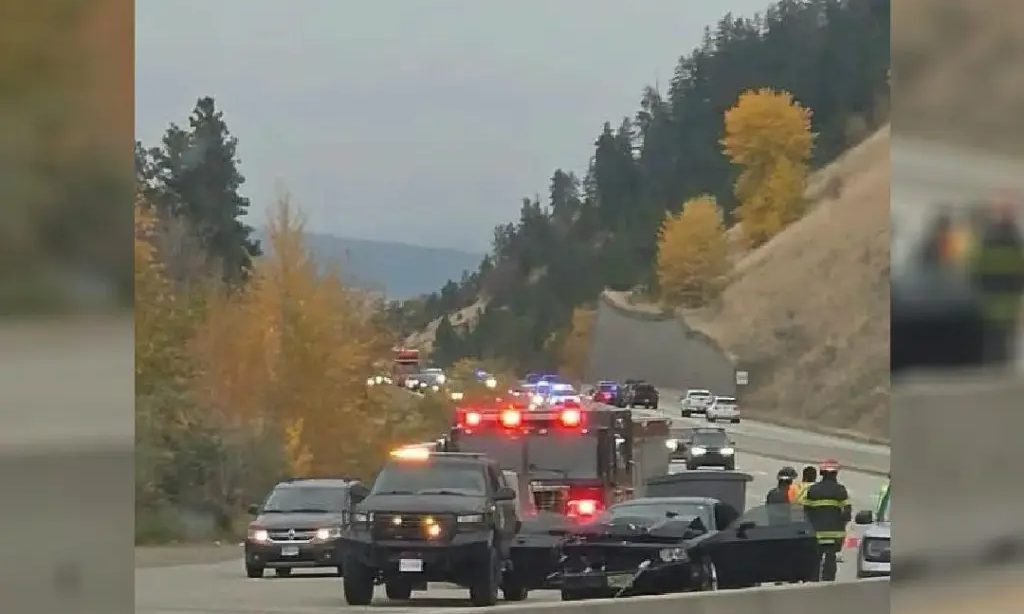
Hit-and-Run Incident Causes Traffic Delay on Highway 97
A driver attempting to flee on foot following a two-vehicle crash on Highway 97 near Ellison Lake was taken into custody by police on Saturday, Oct. 24. The collision in North Kelowna resulted in traffic slowing to a crawl while emergency responders managed the scene.
Extensive Police Response Leads to Arrest
Witnesses contacted authorities after observing the driver of a black sedan abandon the vehicle and run into a nearby green space. Multiple law enforcement teams were dispatched to track down the fleeing suspect, including the Kelowna RCMP Road Safety Unit, the Kelowna RCMP Gang Enforcement Team, frontline officers, Lake Country RCMP, Police Dog Services, and RCMP Air Services.
According to Kelowna RCMP media relations officer Cpl. Steven Lang, officers located and arrested the suspected driver close to the crash site shortly after the search began.
Police Investigation Ongoing
Authorities reported that no injuries occurred as a result of the collision. “Investigators believe alcohol and speed were factors in the collision,” Lang stated.
HEALTH
Coquihalla Highway Reopens Near Merritt Following Morning Crash That Injured Four
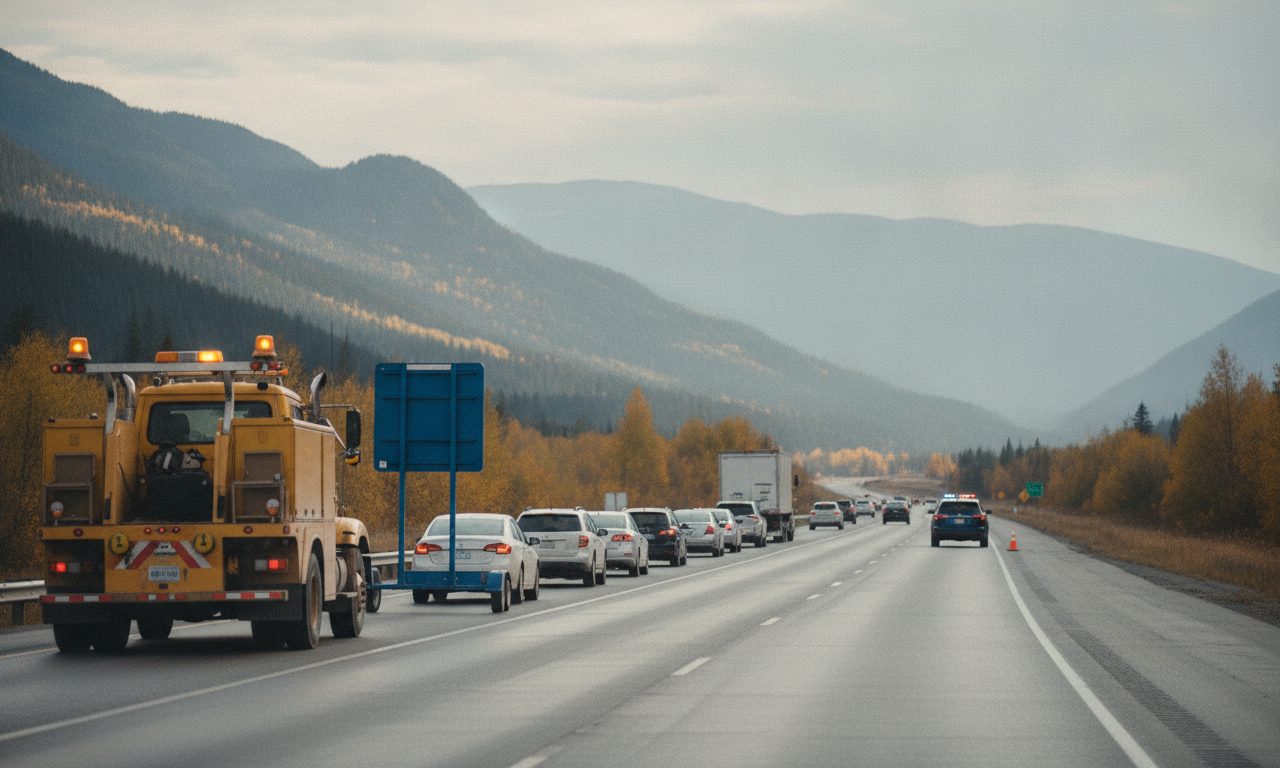
The Coquihalla Highway north of Merritt has reopened following a Saturday morning vehicle crash that resulted in four people being taken to the hospital.
Traffic Resumes Following Serious Morning Incident
Four people were hospitalized, including three in critical condition, after a motor vehicle incident occurred north of Merritt on Saturday morning, October 17.
DriveBC reported that the Coquihalla Highway was reopened in both directions from Exit 290 to Exit 315 at approximately 4:00 p.m., following the earlier closure.
Emergency Responders Deploy Air Ambulances
BC Emergency Health Services dispatched multiple resources after receiving a call at approximately 8:35 a.m. The response included two air ambulances, three primary care paramedic ambulances, one advanced care paramedic ambulance, and a paramedic supervisor.
According to BCEHS, crews provided emergency medical care at the scene. Two of the three critically injured patients were flown to the hospital via air ambulance, while a fourth patient was taken to the hospital in stable condition.

Why the Early Election Gamble Backfired on the NDP

Why Fake Signs Targeted a Small Green Party Campaign on B.C. Election Eve

Why the Conservatives’ Majority Win in Kelowna-Mission Signals Big Changes for Local Healthcare and Economy

Why B.C.’s Latest Election Results Are Sparking Renewed Calls for Voting Reform
Your Current 3 Day Forecast — October 27, 2026
Why First Nations Leaders Are Gathering in Ottawa to Push Back on Fast-Tracked Resource Projects

Opinion: John Rustad Has to Go

B.C. Supreme Court Grants Cowichan Tribes Title to Historic Richmond Lands and Fishing Rights

Vancouver Canucks Gear Up for a Make-or-Break 2025–26 Season

BC Ferries Sparks Outcry Over Contract with Chinese Shipyard

Kamloops Blazers Announce Off-Season Changes Ahead of 2025–26 Season

A Taste of Autumn: Fall Okanagan Wine Festival 2025
-

 SPORTS5 days ago
Why B.C. Lions Starters Are Resting as the Regular Season Concludes Against Winnipeg
-
 BC STORIES5 days ago
BC Conservatives Promise Forestry Overhaul to Revive Jobs as NDP Points to Millions in Existing Investment
-

 OPINIONS5 days ago
How Minor Parties and Strategic Balloting Could Shift the Upcoming B.C. Election
-
 BC STORIES6 days ago
Police Seek Witnesses After Fatal Wrong-Way Collision Near Merritt
-
5 days ago
Your Current 3 Day Forecast — October 22, 2026
-
6 days ago
Your Current 3 Day Forecast — October 21, 2026
-
NATIONAL STORIES6 days ago
Highland Valley Copper Workers Could Strike Saturday as Union Issues Notice
-
 HEALTH6 days ago
Coquihalla Highway Reopens Near Merritt Following Morning Crash That Injured Four